

New book: Postcolonial Transition and Global Business History (Routledge 2023)

Dear subscribers,

It is publication day for Prof Stephanie Decker — Postcolonial Transition and Global Business History: British Multinational Companies in Ghana and Nigeria (Routledge 2022) is out now!

Summary

British multinationals faced unprecedented challenges to their organizational legitimacy in the middle of the twentieth century as the European colonial empires were dismantled and institutional transformations changed colonial relationships in Africa and other parts of the world. This study investigates the political networking and internal organizational changes in five British multinationals (United Africa Company, John Holt & Co., Ashanti Goldfields Corporation, Bank of West Africa and Barclays Bank DCO). These firms were forced to adapt their strategies and operations to changing institutional environments in two English-speaking West African countries, Ghana (formerly the Gold Coast) and Nigeria, from the late 1940s to the late 1970s. Decolonization meant that formerly imperial businesses needed to develop new political networks and change their internal organization and staffing to promote more Africans to managerial roles. This postcolonial transition culminated in indigenization programmes (and targeted nationalizations) which forced foreign companies to sell equity and assets to domestic investors in the 1970s. Managing Postcolonial Transitions is the first in-depth historical study on how British firms sought to adapt over several decades to rapid political and economic transformation in West Africa.

Author Biography

Stephanie Decker is professor of Strategy at the University of Birmingham Business School, UK, and visiting professor in African Business History at the University of Gothenburg, Sweden. She is joint editor-in-chief of Business History, on the editorial board of Organization Studies, Journal of International Business Studies and Accounting History, and Co-Vice Chair for Research & Publications at the British Academy of Management.

Table of Contents

  1. Introduction.
  2. Organizational Legitimacy and the Development Discourse.

PART 1 – Managing Postcolonial Transitions Externally .

  1. Corporate Political Activities before and after Independence.
  2. Indigenization Programmes and Organizational Legitimacy.

PART 2 – Managing Postcolonial Transitions Internally.

  1. Africanization in Companies and in the Civil Service.
  2. African Managers in British Businesses.
  1. Conclusions.

Appendices.

1. Introduction

This chapter introduces the book and provides an overview of key terms and the historical context, the companies selected for the study, and the country context. The term postcolonial transition describes the changes in countries like Ghana and Nigeria during decolonization and the first two decades of independence. Multinationals became increasingly aware of the need to build goodwill with domestic stakeholders. The book details their legitimization strategies, especially in terms of corporate political activities (Part 1) and Africanization (e.g., promoting African staff to positions of responsibility, Part 2). The introduction reviews the relevant literature, covering several different topics, such as decolonization and development thinking, economic nationalism and expropriations, Africanization and business historical studies of corporate legitimacy.

2. Organisational Legitimacy and the Development Discourse

Development economics emerged as a discipline out of World War 2 and its aftermath. Development ideas came to shape the legitimization strategies of imperial business during decolonization and continued to do so after independence. This chapter traces the nature of this development discourse internationally, specifically in West Africa, and how it shaped corporate responses to political and economic change. The influence of development discourse went beyond corporate strategies to foster political goodwill. It influenced commercial strategies such as refocusing activities and expansion beyond urban areas. By the late 1960s, this development discourse was under strain, and with it, multinationals found it more challenging to maintain the legitimacy of their subsidiaries.

3. Corporate Political Activities Before and After Independence

Corporate political activities became a major focus for British multinationals in West Africa as decolonization became a political reality. This chapter outlines how firms framed their key concerns over time and how this changed during decolonisation and after independence. Companies varied their legitimisation strategies from building personal networks to collective action. Whilst their focus was on colonial officials in the late 1940s and early 1950s, many companies began developing contacts with nationalist politicians and traditional rulers in Ghana and Nigeria in the 1950s. This strategy continued after independence, even though firms faced greater criticism in the 1960s and 1970s.

4. Indigenization Programmes and Organizational Legitimacy 

This chapter focuses on the expropriations and indigenization programmes of the late 1960s and 1970s in Nigeria and Ghana. It traces the complex sequence of different types of local content legislation and analyzes the corporate responses to these programmes. The Nigerian Enterprise Promotion Decrees were amongst the most comprehensive of these programmes in Africa. They were introduced when Nigeria realized windfall profits from its oil and petroleum industries, and thus multinationals were paying close attention. Expropriations of foreign companies in West Africa and beyond have been of interest to researchers in economic sociology, law, international business, and history. The final section engages with these debates based on the archival evidence from multinationals in Ghana and Nigeria.

5. Africanization in Companies and the Civil Service

In this chapter, the progress of Africanization in the civil service and in companies is compared to understand better what were the drivers and constraints of these changes. Progress in the private sector also varied between industries and companies, reflecting different legitimization strategies espoused by firms. Whilst Africanization progressed fastest in commercial companies, UAC was certainly more advanced than Holts. Banking generally lacked behind the commercial sector, and the archival records from BWA were not sufficiently detailed for a comparison. Mining was slowest; this may reflect AGC being particularly resistant under the leadership of Edward Spears to Africanize. Finally, this chapter investigates some of the factors that limited effective Africanization: high staff turnover due to significant skills shortages, ceilings to African advancement, and colonial salary structures that continued with limited reform into the independence period.

6. African Managers in British Businesses

Promoting African staff in formerly imperial British multinationals required significant changes to internal operations in organizations shaped by expatriate leadership. This chapter first discusses the changing relationship between expatriates and Africans and how companies constructed the notion of cultural and social distance between these two groups of employees. Many firms opted to develop staff training schemes to imbue corporate cultures and expectations to prepare Africans for management. British business leaders were concerned about whether they could trust their African staff, especially at times of rising anti-colonial and nationalist sentiment. As a group of employees, African staff also became more fractured in their interests – those who were promoted to managerial positions and better benefits and those who were not. In mining, the question of whom the African trade unions could represent and whether that included African managers led to conflicts. The rising economic nationalism of the 1970s created more opportunities for African managers in senior leadership positions in multinationals and to go alone in an entrepreneurial venture, sometimes competing with their former employers.

7. Conclusion

This chapter concludes the book and summarizes its main arguments: the type of legitimization strategies firms espoused to manage the postcolonial transition period in Ghana and Nigeria strategically. They relied on the then-dominant development discourse to frame their commercial activities, expanded their political networks, and began to advance their African staff to more responsible positions. As the post-war development framework lost its relevance in the face of economic difficulties, multinationals found their organizational legitimacy undermined. Expropriations and indigenization decrees often required multinationals to rely even more on their African managers, who benefitted from these opportunities for investment and advancement. Whilst the debate has usually focused on the question of control over foreign-dominated sectors of the economy, this book argues that legitimacy theory provides a better understanding of the strategies and constraints that multinationals were facing in West Africa and beyond.
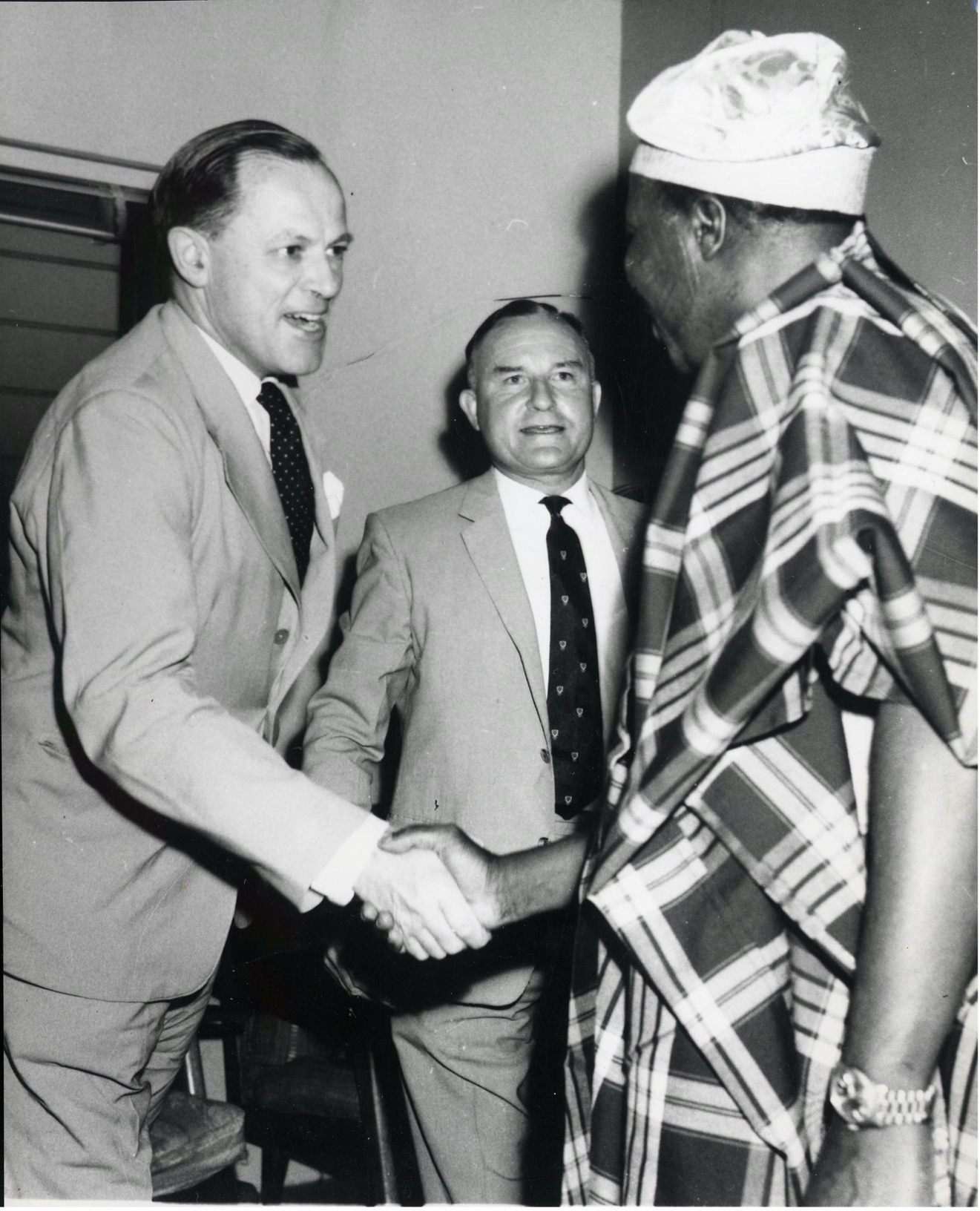
Photograph of Richard Dyson (on the left) of Barclays Bank meeting Samuel Akintola, Premier of Nigeria’s Western Region, in 1964. Reproduced with kind permission of Barclays Group Archives.


PDW on business education at BHC 2023

Educating for business – and the business of education

Historical Perspectives and developments

CBS Paper Development Workshop

Business History Conference, Detroit, March 16-18, 2023

The past years have seen an increasing scholarly interest in the historicity of management
learning and education. Studies on historical interrelations between business and education
have appeared as journal contributions and special issues across diverse fields such as
business history, management- and entrepreneurship studies, and didactical research (Bok,
2009; Bridgman et al. 2016; Clinebell, & Clinebell 2009; Khurana 2007; Spender, 2016;
Wadhwani & Viebig 2021), as business schools and educational programs in management
are increasingly seen as having a transformational potential to address present-day global
challenges. Instead of merely educating for business, business school curricula and didactics
are now focused on educating for sustainable solutions and addressing grand challenges
(Gatzweiler et al. 2022).

In the PDW we focus on historicity of business education and, and we would like to explore
recent developments as well as theories and methods that might shed new light on the
historical development of business education.

The workshop offers an opportunity to get feedback and generate ideas of how to develop
concrete paper drafts that deal, one way or the other, with historical aspects of business
education. In addition, the PDW will serve as a forum where we can discuss future directions
and opportunities for historical studies within the area. What questions and research that are
yet to be explored? And what are the role for historians in shaping agendas and research
questions?

Themes to be explored in the papers could include, amongst others:

  • The role and development of entrepreneurship education
  • The historicity of business- and management education
  • Historical responses to grand societal challenges
  • Future directions of business education
  • Business school pedagogy and didactics in historical perspective
  • The historical development of business education curricula
  • Theoretical and methodological perspectives connected to business education

Submitted texts could take form as extended abstracts or full paper drafts. The important
thing is that readers can identify the key arguments, theories, and empirical material, for them
to provide useful feedback, suggestions, and comments.
The PDW is developed in the context of a special issues call on entrepreneurship education
in Management & Organizational History. Potential authors for the special issue are encouraged
to participate in the workshop, but the PDW is not limited to contributions for this
publication.

Participants are expected to read all circulated papers. Please submit a paper draft or extended
abstract before January 10, 2023 to the workshop organizers.

  • Christoph Viebig, CBS Centre for Business History: cvi.mpp@cbs.dk
  • Anders Ravn Sørensen, CBS Centre for Business History: ars.mpp@cbs.dk

References

Bok, D. (2003). Universities in the marketplace: The commercialization of higher education.
Princeton, N.J.: Princeton University Press.

Bridgman, T., Cummings, S., & McLaughlin, C. 2016. “Restating the case: How
revisiting the development of the case method can help us think differently about
the future of the business school”. Academy of Management Learning & Education, 15(4):
724-741.

Clinebell, S. K., & Clinebell, J. M. (2009). The tension in business education between
academic rigor and real-world relevance: The role of executive professors. Academy
of Management Learning & Education, 7(1), 99-107.

Khurana, R. (2007). From higher aims to hired hands: The social transformation of American
business schools and the unfulfilled promise of management as a profession. Princeton: Princeton
University Press.

Khurana & Spender, J. C. 2012 “Herbert A. Simon on What Ails Business Schools:
More than ‘A Problem in Organizational Design’. Journal of Management Studies,
49: 619–639.

Wadhwani & Viebig (2021) “Social Imaginaries of Entrepreneurship Education: The
United States and Germany, 1800–2020“ Academy of Management Learning & Education
20(3).

Gatzweiler et al. (2022) “Grand Challenges and Business Education: Dealing with
Barriers to Learning and Uncomfortable Knowledge”, in Research in the Sociology of
Organizations, Vol. 79, pp. 221-237.

Business Archives Council News

The BAC Wadsworth Prize was awarded to Greg Finch this year for his book The Blacketts: A Northern Dynasty’s Rise, Crisis and Redemption, published by Tyne Bridge Publishing in 2021. It has been reviewed in Business History by John Wilson. 

Because the BAC’s Annual Research Support Bursary had not been awarded since 2018, three grants were made, to: 

  • Chris Corker, to support the completion of a project on the history of stainless steel
  • Lewis Smith, to access the National Gas Archive and History of Advertising Trust to analyse how nationalised industries fed into issues such as gender, masculinity and public service
  • Emma West, for her project ‘Art in the Pub: Democracy, Community and Gender’, which will explore how brewers made arts and cultural activities available to pubgoers from the 1930s to the 1960s. 

The BAC Cataloguing Grant was awarded was given to the Arts University Bournemouth for work on the Thorp Modelmaking Archive, a unique collection of photographs and documents recording the history of the oldest architectural modelmakers in Britain. The company was founded in 1883. 

Some ABH members may also be unaware of the sad news that Lesley Richmond died on 28 September. Lesley was the former University Archivist, where she managed the Scottish Business Archive, and Deputy Director of the Centre for Business History in Scotland, both at the University of Glasgow. She wrote extensively about business archives and produced several guides to business archive collections, as well as undertaking surveys of business archives still in private hands. Many business history researchers will have benefitted from her knowledge and expertise.

New Audio Article – Whiskey and Dynamic Capabilities

Do you want one of your articles available as an audio version? Send out a message at Orghist.com! The article needs to be OA and formatted as a word document designed to be read out. Get in touch for more information.

This week, we are making another audio version of an Open Access article available as a podcast. This article appeared in “Business History” advance online in June 2022.

Unlocking Dynamic Capabilities in the Scotch Whisky Industry, 1945 to present

By Niall G MacKenzie, Adam Smith Business School, University of Glasgow.

Andrew Perchard, Northumbria University.

David Mackay, Hunter Centre for Entrepreneurship at the University of Strathclyde.

George Burt, Stirling Management School, University of Stirling.

Abstract

In this article we examine the development of the Scotch whisky industry since 1945 through the lens of dynamic capabilities. We explain how sui generis acts – novel initiatives outwith the established repertoire of practices of a firm or industry – by external actors joining the industry helped unlock dynamic capabilities at the firm level in the industry which in turn drove change across the sector after a series of takeovers. We detail the key structural changes in the Scotch whisky industry and demonstrate how important external actors can be in effecting sector level change by extending and connecting our analysis to existing debates in business history and strategy research.

https://anchor.fm/orghist/embed/episodes/3–Whiskey-and-Dynamic-Capabilities–by-Mackenzie-et-al—Business-History–2022-e1r6kdg

CfP Tony Slaven Doctoral Workshop in Business History

Newcastle Business School
Northumbria University
29 June 2023

The ABH will hold its tenth annual Tony Slaven Doctoral Workshop on 29 June 2023. This event immediately precedes the 2023 ABH Annual Conference at Newcastle Business School, Northumbria University. Participants in the Workshop are encouraged to attend the main ABH Annual Conference following the Workshop. They will also have an opportunity to participate in the Poster Competition (explained in the main call for papers). The Workshop is an excellent opportunity for doctoral students to discuss their work with other research students and established academics in business history in an informal and supportive environment. It is important to note that this will not be a hybrid event and all participants need to attend the workshop in person. Students at any stage of their doctoral studies, whether in their first year or very close to submitting, are urged to apply. In addition to providing new researchers with an opportunity to discuss their work with experienced researchers in the discipline, the Workshop will also include at least one skill-related session. The Workshop interprets the term ‘business history’ broadly, and it is intended that students in areas such as (but not confined to) the history of management and organizations, international trade and investment, financial or economic history, agricultural history, the history of not-for- profit organisations, government-industry relations, accounting history, social studies of technology, and historians or management or labour will find it useful. Students undertaking topics with a significant business history element but in disciplines other than economic or business history are also welcome. We embrace students researching any era or region of history. Skills sessions are typically led by regular ABH members; in the past these have included ‘getting published’, ‘using historical sources’, and ‘preparing for your viva examination’ sessions. There will be ample time for discussion of each student’s work and the opportunity to gain feedback from active researchers in the field.

How to Apply for the Tony Slaven Workshop

Your application should be no more than 4 pages sent together in a single computer file: 1) a one-page CV; 2) one page stating the name(s) of the student’s supervisor(s), the title of the theses (a proposed title is fine), the university and department where the student is registered and the date of commencement of thesis registration; 3) an abstract of the work to be presented.

If selected for the workshop, you will be asked to prepare a 15-minute presentation that is either a summary of your PhD project (giving an overview of the overarching themes, research questions, and methodologies) or a chapter/paper.

You may apply via email to Dr Michael Aldous at m.aldous[at]qub.ac.uk. Please use the subject line “Tony Slaven Workshop” and submit by 24 March 2023.

Call for Coleman Prize for Best PhD Dissertation

Association of Business Historians Annual Conference
Newcastle Business School
Northumbria University
30 June-1 July 2023

Named in honour of the British business historian Donald Coleman (1920-1995), this prize is awarded annually by the Association of Business Historians to recognise excellence in new research in Britain. It is open to PhD dissertations in Business History (broadly defined) either having a British subject or completed at a British university. All dissertations completed in the previous year (2022) to that of the Prize are eligible. In keeping with the ABH’s broad understanding of business history, applications are strongly encouraged from candidates in economic history, social history, labour history, intellectual history, cultural history, environmental history, the history of science and technology, the history of medicine, or any other subfield. The value of the prize is £500, sponsored by the Taylor & Francis Group, a scholarly publisher. To be eligible for the Prize, finalists must present their findings in person at the Association’s annual conference, held on 29th June-1st July 2023. A complete list of previous winners may be found at: http://www.gla.ac.uk/external/ABH/coleman.html

How to Apply for the Coleman Prize

Supervisors are encouraged to nominate recent PhDs, and self-nominations are also strongly welcomed. Please send a PDF including the title of your PhD dissertation and a brief abstract (up to 2 double-spaced pages) to christine.leslie@glasgow.ac.uk by 24 February 2023. Shortlisted candidates will be requested to submit electronic copies of their theses 17 March 2023. Finalists will be notified by 14 April 2023.

Everyone appearing on the programme must register for the meeting. PhD students whose papers are accepted for the meeting may apply for funds to partially defray their travel costs by applying to the Francesca Carnevali Travel Grant for PhD Students. A limited number of scholarships are available from the Francesca Carnevali fund of the ABH to contribute towards the travel, accommodation and registration costs of students doing a PhD in the United Kingdom, who are presenting in the Slaven Workshop, the ABH conference or the Coleman Prize.

Further details can be found at – https://www.gla.ac.uk/external/ABH

V&A Exhibition: Tropical Modernism in West Africa and India

Exciting news that The V&A is planning an exhibition with emphasis on the architecture of Tropical Modernism in West Africa and India. The exhibition…

V&A Exhibition: Tropical Modernism in West Africa and India

New audio article available: “Finding Light in Dark Archives”

Do you want one of your articles available as an audio version? Send out a message at Orghist.com! The article needs to be OA and formatted as a word document designed to be read out. Get in touch for more information.

This week, we are making another audio version of an Open Access article available as a podcast. This article appeared in “AI & Society”, 2022, volume 33.

Finding light in dark archives: Using AI to connect context and content in email

By:

  • Stephanie Decker, University of Bristol, UK
  • David A. Kirsch, Robert H. Smith School of Business University of Maryland, USA
  • Santhilata Kuppili Venkata The National Archives (UK)
  • Adam Nix University of Birmingham, UK

Abstract

Email archives are important historical resources, but access to such data poses a unique archival challenge and many born-digital collections remain dark, while questions of how they should be effectively made available are answered. This paper contributes to the growing interest in preserving access to email by addressing the needs of users, in readiness for when such collections become more widely available. We argue that for the content of email to be meaningfully accessed, the context of email must form part of this access. In exploring this idea, we focus on discovery within large, multi-custodian archives of organisational email, where emails’ network features are particularly apparent. We introduce our prototype search tool, which uses AI-based methods to support user-driven exploration of email. Specifically, we integrate two distinct AI models that generate systematically different types of results, one based upon simple, phrase-matching and the other upon more complex, BERT embeddings. Together, these provide a new pathway to contextual discovery that accounts for the diversity of future archival users, their interests and level of experience.

Keywords: email archives; born-digital collections; computational archival studies; contextual email discovery

Acknowledgement:

We gratefully acknowledge funding support by the Arts & Humanities Research Council (UK) and National Endowment for the Humanities (USA) as part of the US-UK Partnership Development Grants, grant AH/T013060/1.

This article is available #OpenAccess here: https://link.springer.com/article/10.1007/s00146-021-01369-9

Lecturer in Contemporary Economic History (University of Glasgow)

The School of Social and Political Sciences is seeking to appoint a Lecturer in Contemporary Economic History. The post holder will conduct research in an area of contemporary economic and/or business history as well as deliver teaching in the Economic and Social History subject area of the School of Social and Political Sciences. We especially welcome applicants with expertise related to sustainable development, business and globalisation, or energy and the environment, particularly focusing on or within the world regions of Asia or Africa. The successful post-holder will be based in the Economic and Social History subject area, which is home to the Centre for Business History in Scotland.

Submission date: 23 November 2022

For more information, go to: Lecturer in Contemporary Economic History at University of Glasgow (jobs.ac.uk)

Assistant or Associate Professor in Management & Public Policy (Universidad de los Andes)

Assistant /Associate Professors Positions in Management and Public Policy

Job Qualifications:

The School of Management at the University of Los Andes (Bogotá, Colombia) seeks applications to fill one/several full-time positions at the assistant or associate professor level at the Management and Public Policy Unit. The Unit houses scholars interested in management theory (organization theory and organizational/management economics); innovation and technology; business and economic history; family business; cultural industries; and business ethics. Preference will be given to faculty with a strong commitment to research, demonstrated by a record of publications in high-quality peer-reviewed journals or high-potential working papers pipeline, and who will engage in the design, delivery, and assessment of courses at the undergraduate and graduate level. This call will prioritize high quality candidates who will strengthen our existing fields but will also consider applications from high quality candidates in other relevant fields.

We are interested in candidates with:

  • A Ph.D. – completed or near completion in the field of business, management, economics, history or other relevant fields.
  • A desire and aptitude to contribute to a successful and fast-growing educational establishment.
  • Potential for research and publication in international peer-reviewed journals.
  • An ability to contribute to different undergraduate and postgraduate programs.

Applications:

Applicants should submit the following:

  • Cover letter.
  • Curriculum vitae.
  • 2 (at least) reference letters.
  • A statement of teaching, including course evaluations.
  • A statement of research.
  • A copy of two recent working papers.

Send electronic versions of your application package to adm-recruit@uniandes.edu.co. Only complete applications will be considered.

Processing of applications will begin Jun 1, 2022, until vacancy completion. Appointments start on any time after June 1 – 2023. The level of compensation is competitive internationally and will be determined based on education and experience following University guidelines. Detailed information will be provided once the candidate is offered a position