The success of the Barbie movie, grossing over a billion dollars globally, can be in part attributed to the innovative and unexpected portrayal of the iconic doll. It is not only the symbol of unachievable beauty standards, but also a tale of emancipation and feminist resistance in a patriarchal society. Our article, published online the 1st of June 2023 in Business History(https://doi.org/10.1080/00076791.2023.2215193) explores these themes by focusing on the entrepreneurial journey of the creator of Barbie and founder of the company Mattel, one of the most influential firms in the global toy industry since the 1950s, Ruth Handler. Known as one of the greatest examples of female entrepreneurship in the United States, surely the Barbie movie has reinforced this image and idea about the business woman.
The authors, Valeria Giacomin and Christina Lubinski, summarise their article in a blog post here.
In the article “Entrepreneurship as emancipation: Ruth Handler and the entrepreneurial process ‘in time’ and ‘over time’, 1930s–1980s,” co-authored with Christina Lubinski, we draw from a diverse set of historical sources – including personal archives, oral histories, primary and secondary sources on American female entrepreneurs – to retrace Ruth Handler’s fifty-year entrepreneurial career. Our research avoids the narrative of the heroic entrepreneur and seeks to provide a balanced reconstruction of her business activity. In part, this allowed to investigate the concept of “entrepreneuring” as emancipation theorized in management studies by Violina Rindova and colleagues looking at entrepreneurship as a means of liberation, challenging the status quo to pursue freedom and autonomy.
The image of Ruth Handler that emerges from our analysis is one of controversy and reinvention. The historical perspective helped us uncover Handler’s entrepreneurial process through time and identity. We reconstructed how Handler managed to introduce her unique female perspective in a male-dominated industry, not only through the introduction of Barbie, but also through innovations in marketing and sales that revolutionized the toy industry since the beginnings of Mattel in the late 1940s.
Handler fought to validate her ideas over and over among (primarily) male customers, wholesalers, engineers and even with her husband and business partner Elliot Handler. After the global success of Barbie and the internationalization of Mattel in the 1960s, Handler had to face several controversies. Mattel was criticized for advertising directly to kids through television ads such as the ones of toy guns and rifles. Barbie ads were criticized for promoting unrealistic beauty standards to young girls. While battling against breast cancer in the 1970s, Ruth also faced an indictment and prosecution for fraud and tax evasion at Mattel, which resulted in her permanent departure from the company.
Despite these challenges, Handler spent the last fifteen years of her active business life in rebuilding her image and she did that once again through entrepreneurship. She founded NearlyMe, a company specializing in breast prostheses and lingerie for women who had undergone mastectomies. The analysis shows how Handler applied several innovations leveraging on her experience at Mattel. She also employed cancer survivors as sales agents throughout the US to promote her product. Albeit never particularly profitable, this social enterprise helped Handler to mend her tarnished reputation. Eventually she returned to Mattel’s Barbie collectors’ events as guest of honor in the 1990s. Ruth Handler story of entrepreneurial emancipation challenges conventional narratives on female entrepreneurship by offering fresh insights on strategies and disruptive forces employed by women in male-dominated environments.
It is our pleasure to announce that digital evaluation copies of the newly released ninth edition of The Evolution of Management Thought are now available. Designed for upper-level and graduate courses, this new edition further cements The Evolution of Management Thought’s place, over the past half-century, as the field of management history’s leading text.
Far more than a chronicle of the historical development of modern management’s many roots, The Evolution of Management Thought is a fascinating telling of how ideas about the nature of work, the nature of human beings, and the nature of organizations have changed throughout history.
The Evolution of Management Thought’s methodology is analytic, synthetic, and interdisciplinary. It is analytic, in that it examines the backgrounds, experiences, and beliefs of people who made significant contributions to management thinking. It is synthetic, in that it weaves developmental trends, social movements, and environmental forces into a conceptual framework for understanding how management thinking has evolved within and across generations. It is interdisciplinary, in that it draws insights from economics, history, political science, psychology, and sociology to explain why management thinking has developed as it has.
This new edition traces the intellectual history of modern management thought as an activity and as an academic discipline in a way that makes reading The Evolution of Management Thought a thoroughly enjoyable encounter.
We remain grateful for the suggestions and encouragement of the many people who have used previous editions of The Evolution of Management Thought in the classroom and in their own research. For more information, or if you have any questions, please feel free to contact us.
Sincerely,
Daniel A. Wren and Arthur G. Bedeian – abede@lsu.edu
SAGE Publications has established a new Editors’ Choice Collection for Accounting History on the theme “Women and Accounting’s Past”. The articles in this new collection are freely available for a limited period from 1st July-30th September 2023 and are found at the following link: https://journals.sagepub.com/page/ach/collections/editors-choice/women
This replaces a prior Editors’ Choice Collection on the same topic from 2015, which has been archived. That page can also be found at the end of the Editors’ Collection page.
There are now 20 Editors’ Choice Collections for Accounting History, with the series designed to cover key themes within the accounting history field. These are updated and refreshed from time to time. Details relating to the other Collections are available at the following link: https://journals.sagepub.com/page/ach/collections/editors-choice/index.
In order to receive journal Contents alerts, please click on the “Sign Up” button located in the “Connect with us” box on the journal home page found at: http://journals.sagepub.com/home/ach
We hope that you find the newly-added collection, as well as the previous ones, to be helpful and enjoyable reading!
How does a movement unite the disparate interests of producer and consumers? By directing their shared ire against a powerful middleman. That is how opponents of the Standard Oil monopoly on kerosene refining and distribution joined forces to take on the corporate giant. In his dissertation project, Minseok Jang, PhD candidate at the University of Albany, explores the materiality of kerosene and its impacts on people at every link in the commodity chain, from oil fields through refineries and pipelines to the homes and businesses of end-users. Jang argues that the unique qualities contemporaries perceived in kerosene created both opportunities and risks. When Standard Oil attempted to monopolize the opportunities while externalizing the risks, the firm goaded an array of people into united anti-monopolist action.
In support of his work, Jang received an exploratory grant from the Center for the History of Business, Technology, & Society at the Hagley Museum & Library.
Recorded on Zoom and available anywhere once they are released, our History Hangouts include interviews with authors of books and other researchers who have use of our collections, and members of Hagley staff with their special knowledge of what we have in our stacks. We began the History Hangouts earlier this summer and now are releasing programs every two weeks on alternate Mondays. Our series is part of the Hagley from Home initiative by the Hagley Museum and Library. The schedule for upcoming episodes, as well as those already released, is available at https://www.hagley.org/hagley-history-hangout.
SAGE Publications has established a new Editors’ Choice Collection for Accounting History on the theme “Accounting Biographies”. The articles in this new collection are freely available for a limited period until 30th May 2023 and are found at the following link:https://journals.sagepub.com/page/ach/accountingbiographies?pbEditor=true.
This augments the prior Editors’ Choice Collection on the same topic from 2015 and will be a handy reference for authors seeking to submit on any of the upcoming Special Issues (see: https://journals.sagepub.com/page/ach/call-for-papers) or a general issue of the Journal.
There are now 22 Editors’ Choice Collections for Accounting History, with the series designed to cover key themes within the accounting history field. These are updated and refreshed from time to time. Details relating to the other Collections are available at the following link: https://journals.sagepub.com/page/ach/collections/editors-choice/index.
In order to receive journal Contents alerts, please click on the “Sign Up” button located in the “Connect with us” box on the journal home page found at: http://journals.sagepub.com/home/ach
We hope that you find the newly-added collection, as well as the previous ones, to be helpful and enjoyable reading!
On September 22, 2022, the BHC held its second annual mid-year meeting. The theme of the virtual event was “Method and Madness: Historical Interpretation in a New Age of Extremes.” One-hundred, twenty-six people participated, 41 percent of whom were emerging scholars and 55 percent of whom were based outside the United States.
We are pleased to announce the publication of a collection of peer-reviewed essays based on the conference. The essays all touch of the value of play and playfulness in research methods – especially during historical moments of uncertainty and transformation. They are grouped into four themes: new sources of play, seeing anew, sensing new connections, and entertaining new representations. A list of the essays can be found below and they are all freely available until September and can be found here.
Adam Nix and Stephanie Decker recently took part in a fascinating workshop on digital archives at the Cabinet Office in London, organized by the fantastic LUSTRE network. The overall aim of the LUSTRE project is to connect policymakers with Computer Scientists, Digital Humanists and professionals in the GLAM sector (Galleries, Libraries, Archives and Museums). The project is co-delivered with professionals from the Cabinet Office’s Central Digital and Data Office (CDDO). The recordings from the day are available here.
We talked about our recent paper in AI & Society: Finding light in dark archives: Using AI to connect context and content in email. The practice of digital archival discovery is still emerging, and the approaches future research will take when using digital sources remain unclear. Archival practice has been shaped by paper-based, pre-digital sources and guides assumptions around how researchers will access and make use of such collections. Paradoxically, dealing with the increasing relevance of born-digital records is not helped by the fact that many born-digital collections remain dark, in part while questions of how they should be effectively made available are answered. Our research takes a user perspective on discovery within born-digital archives and seeks to promote more meaningful access to born-digital archives for researchers. In doing so, our work deals with the implications that unfamiliar archival technologies (including artificial intelligence) have on disciplinary traditions in the humanities and social science, with a specific focus on historical and qualitative approaches.
Our work in this area currently focuses on the issue of context within organisational email, and the challenges of searching and interpreting large bodies of email data. We are particularly interested in how effective machine-assisted search and multiple pathways for discovery can be used to open contextually opaque collections. Such access is likely to leverage a collection’s structural and content characteristics, as well as targeted archival selection and categorisation. We ultimately suggest that by combining relatively open user-led interfaces with pre-selective material, digital archives can provide environments suited to both the translation of existing research practices and the integration of more novel opportunities for discovery. Our presentation will summarise our progress in this area and reflect on the technical and methodological questions our work here has raised.
Happy Holidays and all the best for the New Year! It’s been a busy year at OHN, and we are taking a well-deserved break until January. But just in case you might get bored in our absence, let us share a few interesting audio resources with you. I know, everyone got into podcasts like two years ago, but there is even more good stuff out now than ever before
This year, we started offering open access articles in organization history in audio formats – for our podcast, visit https://anchor.fm/orghist and see if there is anything there that interests you! So far we have had anything from AI, to methods, to whiskey and the (California) energy crisis. More to come next year, and if you have an OA article out in the field, get in touch if you would like see it as a podcast.
If you want to recap your organization studies classics, check out Talking about Organizations – they look at some of the classics and have a collection on historical approaches on their website.
While we are taking a break from teaching and writing, it might be a good time to consider why we are all publishing, editing, reviewing, or despairing in the academic journal market we have today. Yes, academic publishing has a business history – one that involves Rupert Murdoch (of all people) as a key innovator. It’s quite a story, and it is available as an Audio Long Read from The Guardian, or as a normal long-read article.
It is publication day for Prof Stephanie Decker — Postcolonial Transition and Global Business History: British Multinational Companies in Ghana and Nigeria (Routledge 2022) is out now!
Summary
British multinationals faced unprecedented challenges to their organizational legitimacy in the middle of the twentieth century as the European colonial empires were dismantled and institutional transformations changed colonial relationships in Africa and other parts of the world. This study investigates the political networking and internal organizational changes in five British multinationals (United Africa Company, John Holt & Co., Ashanti Goldfields Corporation, Bank of West Africa and Barclays Bank DCO). These firms were forced to adapt their strategies and operations to changing institutional environments in two English-speaking West African countries, Ghana (formerly the Gold Coast) and Nigeria, from the late 1940s to the late 1970s. Decolonization meant that formerly imperial businesses needed to develop new political networks and change their internal organization and staffing to promote more Africans to managerial roles. This postcolonial transition culminated in indigenization programmes (and targeted nationalizations) which forced foreign companies to sell equity and assets to domestic investors in the 1970s. Managing Postcolonial Transitions is the first in-depth historical study on how British firms sought to adapt over several decades to rapid political and economic transformation in West Africa.
Author Biography
Stephanie Decker is professor of Strategy at the University of Birmingham Business School, UK, and visiting professor in African Business History at the University of Gothenburg, Sweden. She is joint editor-in-chief of Business History, on the editorial board of Organization Studies, Journal of International Business Studies and Accounting History, and Co-Vice Chair for Research & Publications at the British Academy of Management.
Table of Contents
Introduction.
Organizational Legitimacy and the Development Discourse.
PART 1 – Managing Postcolonial Transitions Externally .
Corporate Political Activities before and after Independence.
Indigenization Programmes and Organizational Legitimacy.
PART 2 – Managing Postcolonial Transitions Internally.
Africanization in Companies and in the Civil Service.
African Managers in British Businesses.
Conclusions.
Appendices.
1. Introduction
This chapter introduces the book and provides an overview of key terms and the historical context, the companies selected for the study, and the country context. The term postcolonial transition describes the changes in countries like Ghana and Nigeria during decolonization and the first two decades of independence. Multinationals became increasingly aware of the need to build goodwill with domestic stakeholders. The book details their legitimization strategies, especially in terms of corporate political activities (Part 1) and Africanization (e.g., promoting African staff to positions of responsibility, Part 2). The introduction reviews the relevant literature, covering several different topics, such as decolonization and development thinking, economic nationalism and expropriations, Africanization and business historical studies of corporate legitimacy.
2. Organisational Legitimacy and the Development Discourse
Development economics emerged as a discipline out of World War 2 and its aftermath. Development ideas came to shape the legitimization strategies of imperial business during decolonization and continued to do so after independence. This chapter traces the nature of this development discourse internationally, specifically in West Africa, and how it shaped corporate responses to political and economic change. The influence of development discourse went beyond corporate strategies to foster political goodwill. It influenced commercial strategies such as refocusing activities and expansion beyond urban areas. By the late 1960s, this development discourse was under strain, and with it, multinationals found it more challenging to maintain the legitimacy of their subsidiaries.
3. Corporate Political Activities Before and After Independence
Corporate political activities became a major focus for British multinationals in West Africa as decolonization became a political reality. This chapter outlines how firms framed their key concerns over time and how this changed during decolonisation and after independence. Companies varied their legitimisation strategies from building personal networks to collective action. Whilst their focus was on colonial officials in the late 1940s and early 1950s, many companies began developing contacts with nationalist politicians and traditional rulers in Ghana and Nigeria in the 1950s. This strategy continued after independence, even though firms faced greater criticism in the 1960s and 1970s.
4. Indigenization Programmes and Organizational Legitimacy
This chapter focuses on the expropriations and indigenization programmes of the late 1960s and 1970s in Nigeria and Ghana. It traces the complex sequence of different types of local content legislation and analyzes the corporate responses to these programmes. The Nigerian Enterprise Promotion Decrees were amongst the most comprehensive of these programmes in Africa. They were introduced when Nigeria realized windfall profits from its oil and petroleum industries, and thus multinationals were paying close attention. Expropriations of foreign companies in West Africa and beyond have been of interest to researchers in economic sociology, law, international business, and history. The final section engages with these debates based on the archival evidence from multinationals in Ghana and Nigeria.
5. Africanization in Companies and the Civil Service
In this chapter, the progress of Africanization in the civil service and in companies is compared to understand better what were the drivers and constraints of these changes. Progress in the private sector also varied between industries and companies, reflecting different legitimization strategies espoused by firms. Whilst Africanization progressed fastest in commercial companies, UAC was certainly more advanced than Holts. Banking generally lacked behind the commercial sector, and the archival records from BWA were not sufficiently detailed for a comparison. Mining was slowest; this may reflect AGC being particularly resistant under the leadership of Edward Spears to Africanize. Finally, this chapter investigates some of the factors that limited effective Africanization: high staff turnover due to significant skills shortages, ceilings to African advancement, and colonial salary structures that continued with limited reform into the independence period.
6. African Managers in British Businesses
Promoting African staff in formerly imperial British multinationals required significant changes to internal operations in organizations shaped by expatriate leadership. This chapter first discusses the changing relationship between expatriates and Africans and how companies constructed the notion of cultural and social distance between these two groups of employees. Many firms opted to develop staff training schemes to imbue corporate cultures and expectations to prepare Africans for management. British business leaders were concerned about whether they could trust their African staff, especially at times of rising anti-colonial and nationalist sentiment. As a group of employees, African staff also became more fractured in their interests – those who were promoted to managerial positions and better benefits and those who were not. In mining, the question of whom the African trade unions could represent and whether that included African managers led to conflicts. The rising economic nationalism of the 1970s created more opportunities for African managers in senior leadership positions in multinationals and to go alone in an entrepreneurial venture, sometimes competing with their former employers.
7. Conclusion
This chapter concludes the book and summarizes its main arguments: the type of legitimization strategies firms espoused to manage the postcolonial transition period in Ghana and Nigeria strategically. They relied on the then-dominant development discourse to frame their commercial activities, expanded their political networks, and began to advance their African staff to more responsible positions. As the post-war development framework lost its relevance in the face of economic difficulties, multinationals found their organizational legitimacy undermined. Expropriations and indigenization decrees often required multinationals to rely even more on their African managers, who benefitted from these opportunities for investment and advancement. Whilst the debate has usually focused on the question of control over foreign-dominated sectors of the economy, this book argues that legitimacy theory provides a better understanding of the strategies and constraints that multinationals were facing in West Africa and beyond.
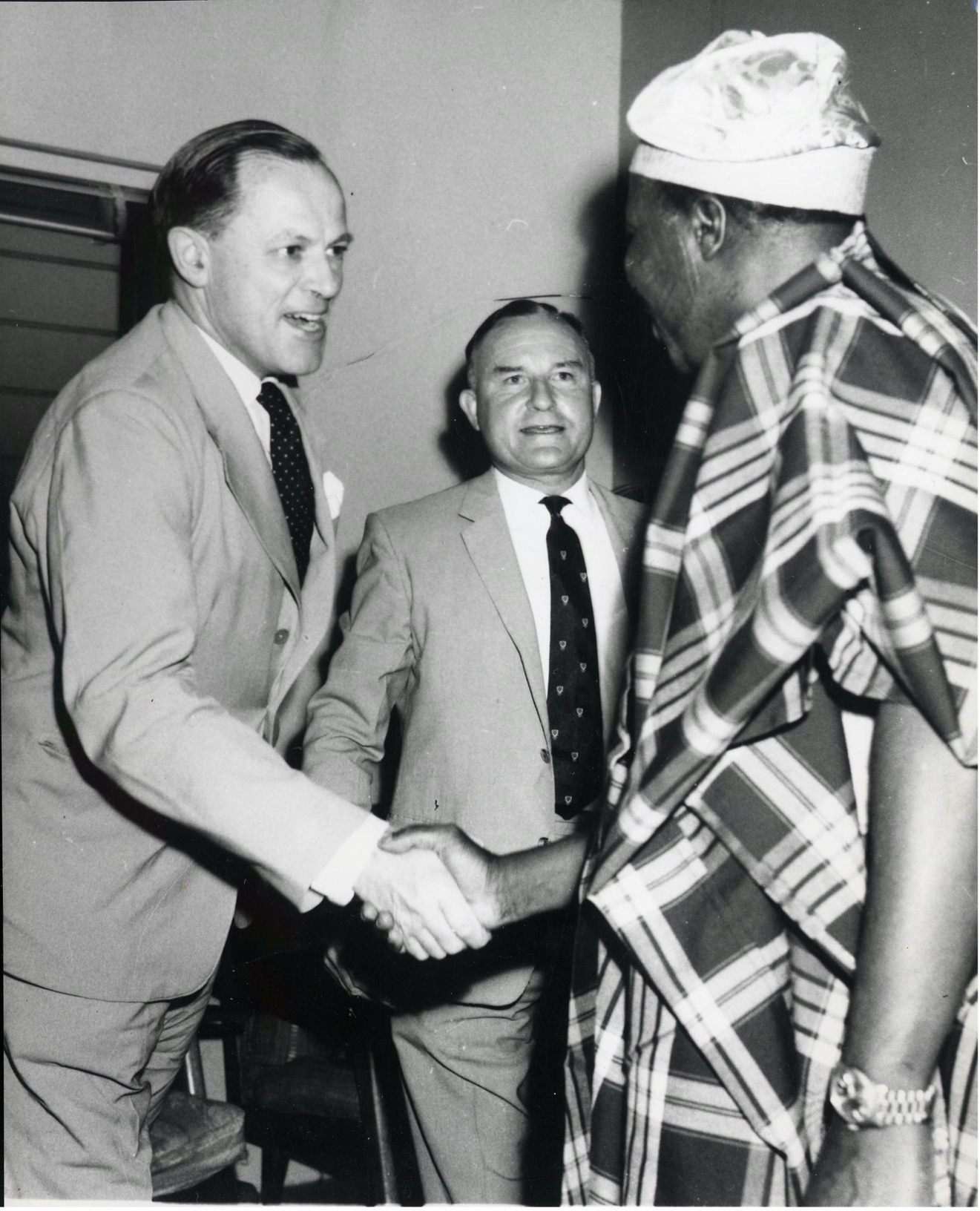
Photograph of Richard Dyson (on the left) of Barclays Bank meeting Samuel Akintola, Premier of Nigeria’s Western Region, in 1964. Reproduced with kind permission of Barclays Group Archives.
The BAC Wadsworth Prize was awarded to Greg Finch this year for his book The Blacketts: A Northern Dynasty’s Rise, Crisis and Redemption, published by Tyne Bridge Publishing in 2021. It has been reviewed in Business History by John Wilson.
Because the BAC’s Annual Research Support Bursary had not been awarded since 2018, three grants were made, to:
Chris Corker, to support the completion of a project on the history of stainless steel
Lewis Smith, to access the National Gas Archive and History of Advertising Trust to analyse how nationalised industries fed into issues such as gender, masculinity and public service
Emma West, for her project ‘Art in the Pub: Democracy, Community and Gender’, which will explore how brewers made arts and cultural activities available to pubgoers from the 1930s to the 1960s.
The BAC Cataloguing Grant was awarded was given to the Arts University Bournemouth for work on the Thorp Modelmaking Archive, a unique collection of photographs and documents recording the history of the oldest architectural modelmakers in Britain. The company was founded in 1883.
Some ABH members may also be unaware of the sad news that Lesley Richmond died on 28 September. Lesley was the former University Archivist, where she managed the Scottish Business Archive, and Deputy Director of the Centre for Business History in Scotland, both at the University of Glasgow. She wrote extensively about business archives and produced several guides to business archive collections, as well as undertaking surveys of business archives still in private hands. Many business history researchers will have benefitted from her knowledge and expertise.




 Organizational History Network