The post holder will contribute to our BSc Management in which we already offer two modules in Business and Management in Historical Context year 1 (compulsory) and Business and History Year 2 (elective). In addition, we would like to add another module in year 3. The post holder will also contribute to the MSc Heritage Management (a program that is directed and mostly delivered by Dr Ed Legon a Social and Business Historian).
We are interested in established lecturers but also (and perhaps especially) in scholars that have just submitted their PhD or achieved their doctorate recently.
Dr Giuliano Maielli
Reader in Organisation Studies Head of Department of Business and Society School of Business and Management Queen Mary, University of London
Thomas Cook Head Office, Peterborough. Image courtesy and copyright BAC.
An archive of business and travel history with national and international significance is to be preserved and secured for the future in the county, after the Record Office for Leicestershire, Leicester and Rutland was selected as the new permanent home of the Thomas Cook archive collection.
The Record Office, which is run by Leicestershire County Council in partnership with Leicester City Council and Rutland County Council, was awarded the honour of housing the internationally significant collection following a bidding process organised by the Business Archives Council and Crisis Management Team for business archives in liaison with the Official Receiver.
The entire Thomas Cook archive, which encompasses records from the earliest days of package travel right up to the modern day, is now being transferred to the Record Office in Wigston.
The Thomas Cook Archive in its new home at the Record Office for Leicestershire, Leicester and Rutland. Image courtesy and copyright Leicestershire County Council.
The huge collection is made up of thousands of individual items, including minute books and staff records, posters, travel guides and timetables. It also features 60,000 photographic images and souvenirs from Thomas Cook’s 178-year history, including glass and china, uniforms through the ages and even a model of a Nile steamer.
The archive will be the single largest collection at the Record Office, which has six miles of shelving representing 1,000 years of the history of Leicestershire, Leicester and Rutland.
The Thomas Cook collection will be thoroughly catalogued by Record Office staff, before being made available to the public.
Senior Archivist at Leicestershire County Council, Robin Jenkins, said: “This is an internationally significant archive relating to a company which began in Leicester and was operated from there in its formative years. We already house an important Thomas Cook collection relating to both the man and his business.
“We see the collection as ‘coming home’ to Leicestershire and we will be delighted to look after it here and promote its use. The collection also fits closely with other local businesses which often originated during the 19th century and have an international reputation – such as Wolsey, Symington and Ladybird Books.”
Leicestershire County Council Leader, Nick Rushton, said: “I am delighted that the Record Office has been chosen as the permanent home for this important collection. The bid was a success because of the strong local links with Thomas Cook, as well as because the Record Office has an excellent reputation for innovative outreach work and the promotion of its collections.
“The fact that the Thomas Cook archive will be housed at the Record Office will preserve it for future generations, as well as providing a valuable resource to the people of Leicestershire, Leicester and Rutland.”
Leicester City Mayor Peter Soulsby added: “Thomas Cook is one of Leicester’s best-known sons, and his pioneering work, which essentially invented the package holiday, means his name became known worldwide. It’s very fitting that this fascinating archive of the company’s history is housed in Leicestershire, so close to where his ground-breaking work in the holiday industry took place.”
Vice President of the Business Archives Council, Alison Turton, said: “‘The deposit of the Thomas Cook archive with the Record Office for Leicestershire, Leicester and Rutland is a landmark achievement. It demonstrates the vital importance of archivists and academics working together with insolvency practitioners to ensure the survival and accessibility of business archives of national importance.”
Professor in History and Strategy at the University of Bristol, Stephanie Decker, who was the independent academic advisor on the selection panel, said: “It’s fantastic news that the Thomas Cook archive has been saved and will be housed in the region where the company began. The archive has local to global relevance and is highly important to anyone interested in the history of travel and leisure.”
Items from the Thomas Cook Archive. Images courtesy and copyright of Leicestershire County Council.
Notes:
Thomas Cook founded his travel company in Leicester and ran his first excursion from there to Loughborough in 1841. The company grew rapidly and by 1855 was running continental tours, opening a London office in 1865. Thomas Cook is credited with inventing the package tour and bringing affordable travel to ordinary people. In 1878, Cook himself retired to Leicester, where he died in 1892. The company he founded became a household name with global reach. It finally ceased trading in September 2019 and a permanent home was sought for its archive.
The bidding for the Thomas Cook archive was supported by Leicestershire County, Leicester City and Rutland County Councils, Leicester and DeMontfort Universities, the East Midlands Oral History Archive and the Media Archive for Central England.
CHORD workshop: ‘Retailing, Architecture and Material Culture: Historical Perspectives’
Tuesday 22 May 2018
University of Wolverhampton, UK
The Centre for the History of Retailing and Distribution (CHORD) invites submissions for a workshop that explores the architecture, material environmement, objetcs and material culture of retailing and distribution.
Papers focusing on any historical period or geographical area are welcome, as are reflections on methodology and / or theory. We invite both experienced and new speakers, including speakers without an institutional affiliation. Potential speakers are welcome to discuss their ideas with the organiser before submission (please see details below). Some of the themes that might be considered include (but are not limited to):
The architecture of shops, markets and retail premises
Retailing and distribution ephemera
Retail exteriors, displays and interiors
The material culture of distribution
Fixtures, fittings and packaging
The restoration and recreation of historical shops
Retailing and town planning
Retail premises in the wider environment
Individual papers are usually 20 minutes in length, followed by 10 minutes for questions and discussion. We also welcome shorter, 10 minute ‘work in progress’ presentations, also followed by 10 minutes for discussion.
To submit a proposal, please send title and abstract of c.300 to 400 words, specifying whether you are proposing a 10 or a 20 minute presentation to Laura Ugolini, at l.ugolini@wlv.ac.uk by 2 March 2018.
If you are unsure whether to submit a proposal or would like to discuss your ideas before submission, please e-mail Laura Ugolini at l.ugolini@wlv.ac.uk
Organizations as heritage and history as a useful resource
Wednesday 5th April 2017
ESRC Seminar Series
Organizations and Society:
Historicising the theory and practice of organization analysis
University of Exeter Business School
Building One: Constantine Leventis Teaching Room
Reception: Xfi Building
10:15-10.30 Refreshments and welcome by seminar series organizers Michael Rowlinson, Stephanie Decker and John Hassard
10.30-11.30 Albert J. Mills (Saint Mary University and University of Eastern Finland), “Insights and Research on the study of Gender and Intersectionality in International Airline Cultures Over Time.”
11:30-11:45 Coffee and biscuits 11:45-12:30 Gabrielle Durepos (Mount Saint Vincent University) “Mobilizing Critical Management History: the example of ANTi-History”
12:30-13:15 Michael Rowlinson & David Boughey (University of Exeter) “Suncor’s Corporate History: Strategic Rhetoric or Cultural Imperative?”
13.15-14:00 Buffet lunch
14:00-14.45 Sara Kinsey (Head of Historical Archives, Nationwide Building Society) “Lights, camera, action: reflections on organizational remembering in practice.”
14:45-15.30 Michael Weatherburn (Imperial College London) “The emerging corporate knowledge gap: why we need our dark archives and ghost data more than we realize.”
15:30-15:45 Tea and biscuits 15:45-16:30 Alan Booth and Morgen Witzel (University of Exeter) “The Rowntree business ‘archives’: uncovering British management in the inter -war period”
16:30-17:15 Roundtable
Speakers: Charles Booth (University of the West of England) Peter Miskell (University of Reading) Anna Soulsby (University of Nottingham)
17:15-19:00 Reception
Please contact Kate Henderson if you plan on attending.
Registration: A limited number of ESRC sponsored free places (including refreshments, buffet lunch and evening reception) will be allocated on a “first come first served” basis to those who contact Kate Henderson asking to attend. A fee of £35.00 will be charged on additional places.
Travel & accommodation: Exeter St. Davids is the nearest train station and is a 5min drive from the university. If needed, Kate Henderson can help with your travel and accommodation arrangements, but cost will need to be covered by participants.
Final event in the ESRC research seminar series “Historicising the theory and practice of organization analysis”
Seminar 6
Organizations as heritage and history as a useful resource
Wednesday 5th April 2017
University of Exeter Business School
Building One: Constantine Leventis Teaching Room
Reception: Xfi Building Programme:
10:15-10.30 Refreshments and welcome by seminar series organizers Michael Rowlinson, Stephanie Decker and John Hassard
10.30-11.30 Albert J. Mills (Saint Mary University and University of Eastern Finland), “Insights and Research on the study of Gender and Intersectionality in International Airline Cultures Over Time.”
11:30-11:45 Coffee and biscuits 11:45-12:30 Gabrielle Durepos (Mount Saint Vincent University) “Mobilizing Critical Management History: the example of ANTi-History”
12:30-13:15 Michael Rowlinson & David Boughey (University of Exeter) “Suncor’s Corporate History: Strategic Rhetoric or Cultural Imperative?”
13.15-14:00 Buffet lunch
14:00-14.45 Sara Kinsey (Head of Historical Archives, Nationwide Building Society) “Lights, camera, action: reflections on organizational remembering in practice.”
14:45-15.30 Michael Weatherburn (Imperial College London) “The emerging corporate knowledge gap: why we need our dark archives and ghost data more than we realize.”
15:30-15:45 Tea and biscuits
15:45-16:30 Alan Booth and Morgen Witzel (University of Exeter) “The Rowntree business ‘archives’: uncovering British management in the inter -war period”
16:30-17:15 RoundtableSpeakers: Charles Booth (University of the West of England) Peter Miskell (University of Reading) Anna Soulsby (University of Nottingham)
17:15-19:00 Reception
Please contact Kate Henderson (r.henderson2@exeter.ac.uk) if you plan on attending.
Registration: A limited number of ESRC sponsored free places (including refreshments, buffet lunch and evening reception) will be allocated on a “first come first served” basis to those who contact Kate Henderson asking to attend. A fee of £35.00 will be charged on additional places.
Travel & accommodation: Exeter St. Davids is the nearest train station and is a 5min drive from the university. If needed, Kate Henderson can help with your travel and accommodation arrangements, but cost will need to be covered by participants.
For further enquiries please contact: Professor Mick Rowlinson (University of Exeter Business School) or Kate Henderson.
‘Private Interests or National Heritage? Corporate Archives and the Production of History in a Global Perspective’
Diego M. Coraiola
Peter B. Gustavson School of Business
University of Victoria
The workshop “Private interest or corporate heritage” put together by Andrew Popp and Susanna Feldman took place in the beautiful city of Gothenburg in the 25th and 26th of November. The workshop brought together corporate archivists, business historians, and organizational theorists to discuss the reasons and practices the state and organizations use to collect, preserve, provide access, and use records from the past. There was a good mix of theoretical frameworks and practical applications and cases. This brought an interesting dynamic to the workshop to the extent that presentations would complement and draw from one another. Theoretical propositions would meet with practical experience and both scholars and practitioners would benefit from an enriched view of organizational mnemonic practices.
The workshop started with Elizabeth Shepherd’s (University College London) keynote speech overviewing the history of archival science and the development of business archives in the UK. It was followed by Mats Jönsson’s (University of Gothenburg) analysis of the private ‘documentary’ ‘Das Dritte Reich’. The movie is based on an assemblage of silent amateur footage of the Nazi regime period to which the voice of a narrator and some other sounds related to the images were added, bringing specific meaning to some of the scenes. Mats then used this case to argue about the importance of media and for the future of historical consciousness. The third presenter was Andrew Smith from the University of Liverpool. Andrew’s paper was a manifest for a transparency revolution in business history. He attempts to sensitize researchers, journals, and publishers for engaging with ‘active citation’ – i.e. the inclusion of hyperlinks with full access to a digitized copy of the sources used in the production of a piece of business history.
The second round of presentations started with Karl-Magnus Johansson and his description of the Gothenburg regional state archives, followed by Anders Houltz from the Swedish Centre for Business History. Both presenters make the point that instead of looking at public and private preservation as concurrent alternatives, it would be better to think about corporate archives as integral to national heritage. While the first presentation reinforced the existing accounts about business archives in Nordic countries by describing how corporations and the state work together in Sweden, Andres introduced the original approach taken by the Center, which provides consulting for organizations on how best use their past, from records keeping to history writing. I took over after them to present a framework in which Stephanie Decker (Aston Univerity) and I try to provide an answer to the question of why organizations remember the way they do. We believe that there is more to the memory of business than private interest or national heritage and we argue that we should pay attention to the institutions at play within an organizational field. Our framework thus identifies for different models of governance for the business and management memory: public governance, private governance, community governance, and representative governance.
Neill Forbes from the University of Coventry presented the case of the digitization of the records of British Telegraph, a very challenging reality for corporate archives, and commented on the possibilities this brings for business history. Ine Fintland and Torkel Thime cheered us with the case of the Norwegian oil and gas archives and the collective project for the preservation of business archives developed by the European companies that gave rise to the European Oil and Gas Archives. After their presentation, Jarmo Luoma-aho introduced us to the Finnish state-based model of business archives and the role of Elka, the Central Archives for Finnish Business Records in preserving business archives as part of the national heritage. Our first day ended with a collective reflection about the subject and a delicious dinner at a local restaurant.
Charles Harvey (Newcastle University) was the keynote speaker for the second day. He did a wonderful job summarizing the historical turn and introducing the notion of rhetorical history to a varied audience of scholars and practitioners. He made a distinction between four types of rhetorical history based on the intended audiences and the frequency in which they are addressed. He also explored the idea of possibly quantifying the contribution of corporate archives based on a formula accounting for the direct value archives add to the business plus the value they add to the society, minus the costs of operation of the archives. In addition to the bright ideas and comments, Charles enlightened us all with an amusing performance of a Scottish cherishing and defending its hundred old invented traditions. After him, Wim van Lent (Montpellier Business School) presented an ongoing project we are working together that focuses on the uses of the past in the East India Company. This is one of the first accounts of a company interested in recording its history, and we hope to understand better the corporate interests and uses in play even before the rise of the modern notion of history and archives.
Andrew Popp (University of Liverpool) delivered the last presentation at the workshop, based on a paper he and Susanna Fellman (University of Gothenburg) are writing together. They main purpose of the paper is to develop a methodological framework based on a stakeholder approach to business archives that contributes to legitimize the research on archives for an audience of management and organization scholars. After the presentations we engaged in an open discussion about possible future plans for this stream of research and wondered about the possibility of bringing close together scholars from organization studies, history, and archival theory through joint conferences, edited volumes, and special issues. I take this opportunity to thank both Andrew and Susanna for their proactive role in organizing this interesting workshop and for the well-planned sessions and the social get together. This was a great event and I hope to see – and maybe contribute to – this idea to grow and flourish in the future.
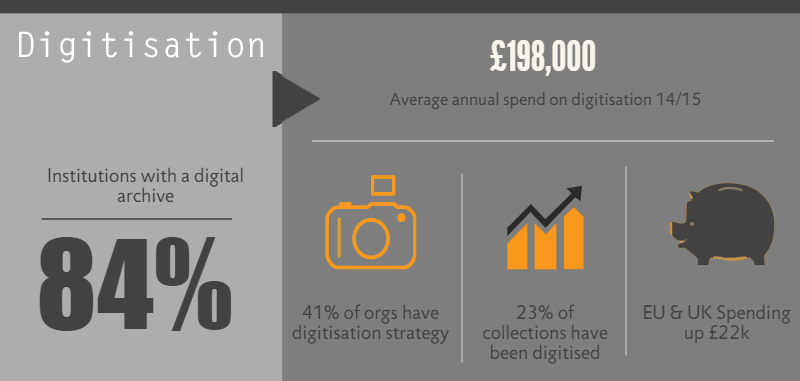
Love it or loathe it, digitisation and digital humanities are becoming and increasingly important area for anyone interested in historical research on organizations. Yet the report by eNumerate, formerly an EU funded project aimed at creating statistical data about the digitization, of cultural heritage in Europe, shows that there is still a long way to go for most archives:
“On average 23%of European collections have been digitised, with Museums leading the way with the highest proportion (31%) up from 24% in the 2014 survey (Core Survey 2- CS2). However at the other end of the scale, only 13% of record office/archive collections and 19% of library collections have been digitised. This is possibly down to the vast amount of records these institutions hold, which could result in a longer digitisation process.”
As this infographic shows, digitisation remains a major area that the UK government and the EU are investing in. Yet the impact this is likely to have on research practices or the availability of documents from private organization archives remains unclear.



 Organizational History Network