
Hagley Center Grants/Fellowships Announcement

by Carol Ressler Lockman

The Center for the History of Business, Technology, and Society, Hagley Museum and Library, Wilmington, Delaware is pleased to announce the recipients of grants and fellowships awarded July 25th, 2019. Please note that the next deadline for applications for the exploratory and Henry Belin du Pont Fellowship is October 31st. The H. B. du Pont Dissertation Fellowship deadline is November 15th. Here is the link on Hagley Museum and Library’s website to apply…. https://www.hagley.org/research/grants-fellowships.

Carol Ressler Lockman

Manager, Hagley Center

PO Box 3630

Wilmington DE 19807

Email:  clockman@hagley.org

302-658-2400, x243

Exploratory Grants:

Anthony Grasso

Assistant Professor

U.S. Military Academy

Privilege and Punishment: Class, Crime, and the Development of the American State

Louisa Iarocci

Associate Professor

University of Washington, Seattle

Bin, Bag, Box: The Architecture of Convenience

Andrew Wasserman

Visiting Assistant Professor

University of North Carolina at Greensboro

The Public Art of Public Relations: Creating the New American City

H. B. du Pont Fellowship

Trish Kahle

Post Doctoral Fellow

University of Chicago

The Graveyard Shift: Coal and Citizenship in an Age of Energy Crisis

Malwina Lys-Dobradin

Ph. D. Candidate

Columbia University

The Historical Trajectory of “Free Enterprise”

Sara Wermiel

Independent Researcher

Massachusetts Institute of Technology

Railroad contractors and the rise of general contractors for buildings

Hagley Exploratory Research Grants

These grants support one-week visits by scholars who believe that their project will benefit from Hagley research collections, but need the opportunity to explore them on-site to determine if a Henry Belin du Pont Fellowship application is warranted. Priority will be given to junior scholars with innovative projects that seek to expand on existing scholarship. Applicants should reside more than 50 miles from Hagley, and the stipend is $400. Application deadlines: March 31, June 30 and October 31

Henry Belin du Pont Fellowships

These research grants enable scholars to pursue advanced research and study in the collections of the Hagley Library. They are awarded for the length of time needed to make use of Hagley collections for a specific project. The stipends are for a maximum of eight weeks and are pro-rated at $400/week for recipients who reside further than 50 miles from Hagley, and $200/week for those within 50 miles. Application deadlines: March 31, June 30 and October 31

Henry Belin du Pont Dissertation Fellowships

This fellowship is designed for graduate students who have completed all course work for the doctoral degree and are conducting research on their dissertation. Applications should demonstrate superior intellectual quality, present a persuasive methodology for the project, and show that there are significant research materials at Hagley pertinent to the dissertation. This is a residential fellowship with a term of four months. The fellowship provides $6,500, free housing on Hagley’s grounds, mail and internet access, and an office. Application deadline: November 15
Jobs: Assistant, Associate and Full Professor of Clinical Entrepreneurship

The Lloyd Greif Center for Entrepreneurial Studies at the Marshall School of Business, University of Southern California, is seeking applicants for a clinical faculty position in entrepreneurship. The position may be at the assistant professor, associate professor, or full professor ranks. We strongly encourage applications from candidates with both a dedication to teaching and a track record of research and/or scholarly contributions to entrepreneurship. The typical teaching load is four courses per year. The job represents a full-time, multi-year academic appointment that is renewable. The job will commence in August 2020.

The Greif Center for Entrepreneurial Studies is a national leader in entrepreneurship education and research. Our faculty is composed of a diverse mix of highly regarded researchers and practitioners. We are a co-sponsor of the West Coast Entrepreneurship Research Symposium and the Greif Entrepreneurship Research Impact Award – awarded annually at the Academy of Management Conference. The Greif Center also prioritizes teaching excellence: our faculty have won multiple USASBE Entrepreneurship Educator of the Year awards and an AOM award for Innovation in Entrepreneurship Pedagogy. Our undergraduate and graduate programs each ranked #9 in the most recent US News and World Report lists. In addition to offering courses in the Marshall School’s undergraduate and MBA programs, we offer specialized graduate degree programs in social entrepreneurship (MSSE) and entrepreneurship and innovation (MSEI).

Preferred qualifications include:

  • Doctoral (or another terminal) degree with entrepreneurship or business-related emphasis.
  • Superior communication and teaching skills, with demonstrated excellence in teaching entrepreneurship courses to undergraduate and/or MBA students.
  • Track record of scholarly contributions to the field of entrepreneurship (e.g., journal articles for academic or practitioner audiences, books or book chapters, teaching cases or other published pedagogical materials, conference presentations).
  • Practical work experience relevant for entrepreneurship (e.g., as founder, manager, or investor in start-ups or as a corporate or social entrepreneur). 

If applicable to your background, please highlight experience in emerging technologies and interdisciplinary work in STEM as well as expertise in venture bootstrapping/finance/investment and negotiation/deal-making. Greif faculty take pride in our work to promote diversity and inclusion in the classroom, and we welcome candidates who help students explore the intersection of entrepreneurship with their unique personal experiences!

Salary and rank are dependent on qualifications, and initial contract length ranges from two to four years based on rank, with the strong expectation that the contract will be renewed if performance expectations are met or exceeded. Employee benefits for full-time faculty are excellent and include tuition assistance for qualifying children and spouses at USC and other participating Universities.

Qualified candidates should apply on-line by midnight PST November 11, 2019. Required documents include 1) cover letter; 2) curriculum vitae that specifies teaching, research, and work experience alongside education; 3) evidence of teaching effectiveness (please include student evaluation results and sample syllabi); 4) two examples of scholarly contributions, and 5) contact information for three references.  Specific details for uploading documents are provided after clicking on the “apply” link.  For questions about the position, please contact the search committee chair, Professor Pai-Ling Yin at pailingy@marshall.usc.edu

USC is an equal opportunity educator and employer, proudly pluralistic and firmly committed to providing equal opportunity for outstanding persons of every race, gender, creed, and background. The University particularly encourages women, members of underrepresented groups, veterans and individuals with disabilities to apply. USC will make reasonable accommodations for qualified individuals with known disabilities unless doing so would result in an undue hardship.

USC Marshall is renowned for its high-ranking undergraduate, graduate, international and executive education programs, an exceptional faculty engaged in leading-edge research, a diverse and creative student body, and a commitment to technological advancement. The research productivity of Marshall’s 200 full-time faculty ranks among the top 10 business schools in the world. For more information about the Marshall School of Business at the University of Southern California, please go to http://www.marshall.usc.edu.

The University of Southern California (USC), founded in 1880, is located in the heart of downtown L.A. and is the largest private employer in the City of Los Angeles. As an employee of USC, you will be a part of a world-class research university and a member of the “Trojan Family.”

New Paper on How Firms Use History

Reblogged from The Past Speaks:

New Paper on How Firms Use History

Paresha N. Sinha, Peter Jaskiewicz, Jenny Gibb, and James G. Combs. “Managing history: How New Zealand’s Gallagher Group used rhetorical narratives to reprioritize and modify imprinted strategic guideposts.” Strategic Management Journal.

Research Summary
Imprinting theory predicts that organizations are imprinted with multiple intersecting imprints that persist. Evidence suggests, however, that imprints are sometimes reprioritized or modified, implying that they can be strategically managed. We draw upon rhetorical history research and an in‐depth historical case study of New Zealand’s Gallagher Group to describe how one firm managed its imprints. Our inductive theorizing links historically imprinted strategic guideposts to decision‐making via two rearranging processes—that is, prioritizing and suspending—wherein managers use narratives to rearrange guideposts’ influence and two scope modifying processes—that is, constraining and expanding—wherein managers change where guideposts apply. As a first explanation of how imprints are managed, these processes add nuance to existing theory and open new research avenues regarding additional processes and boundary conditions.

Managerial Summary
Imprints are elements of culture, strategy, structure, or decision‐making that emerge when the firm is founded or during times of turmoil. Imprints resist change and make organizational adaptation difficult. This study explains one way that managers manipulate imprinted decision‐making rules so that organizations can adapt. Using an in‐depth historical case study of New Zealand’s Gallagher Group from 1938 to 2015, we follow four imprinted decision‐making rules that we call strategic guideposts and show how managers rhetorically revised these rules to adapt organizational decision‐making to changing environments. Managers prioritized some decision‐making rules while deemphasizing others or they changed their claims about the kinds of decisions where a decision‐rule applied. Knowing these rhetorical processes can help managers leverage their organization’s history to facilitate necessary organizational change.

You can access the paper here. You can download the supporting documentation here.

Blog on new research project Cooling for Life Sub-Saharan Africa

This week my co-investigator and I are launching new blog for our research project on solar driven cold stores employing adsorption cooling technology in Rwanda. Historically, the low penetration of electricity has limited economic development because food chains and small-scale subsistence entrepreneurs did not have access to reliable cool chains. Having researched the provision of electricity in Ghana as part of the Volta River Project, it is clear that access to electricity, which is much lower in sub-Saharan African countries than elsewhere (under 30% of population have access), is a key constraint.

So I was really pleased to start talking to one of my colleagues at Aston from engineering, Dr Ahmed Rezk, who wanted to start a project with colleagues in Rwanda on providing off-grid reliable refrigeration for the agro-processing industry. Solar power is obviously plentiful in Africa, but photovoltaic panels actually become less efficient with greater heat. The technology Ahmed proposes is based largely on solar heat (for us less technically versed, think heat pumps running supermarket fridges) which is can be reliably and efficiently exploited in tropical countries.

And in another analogy to the history of development, technologies such as these are not as developed because the creators of technology and products are in countries where the climate makes this a less efficient solutions, while the potential consumers of such technology are in countries with limited technological and manufacturing capacity.

So the other side of our project, which I lead, will look at how we can design business models that will make this new technology user-friendly and affordable to consumers in Africa. Agro-processing is an important area for African countries with a large agricultural sector, for two reasons: it allows exporting and upgrading to other types of products (juices, wines etc.) and it creates more resilient food chains with less spoilage, hence more and better food available locally.

The unparalleled success of mobile phones, micro-finance and bottom of pyramid approaches to expand across sub-Saharan Africa demonstrates that the right business models can lead to significant changes in terms of the products and infrastructure available to producers and consumers. We will blog about our aims and progress at Cooling for life. Any comments or suggestion are very welcome!

EGOS 2020 Hamburg Call for Short Papers

“Call for Short Papers” for the sub-themes at the upcoming 36th EGOS Colloquium in Hamburg, Germany, July 2-4, 2020.

To view the Call for each sub-theme, please go to the EGOS website.

DEADLINE for submission of short papers:

Tuesday, January 14, 2020, 23:59 Central European Time (CET)

Like this year, there are a lot of opportunities to submit historical and retrospective research to EGOS – see for example the following tracks:

Convenors: David Chandler, Majken Schultz, Roy Suddaby
Convenors: Christopher Marquis, Georg Schreyögg, Jörg Sydow
Convenors: Hugh Gunz, Nathalie Louisgrand, Wolfgang Mayrhofer

Further helpful information:

Please follow the instructions given in the “Guidelines and criteria for the submission of short papers at EGOS Colloquia”:

https://eur02.safelinks.protection.outlook.com/?url=https%3A%2F%2Fwww.egosnet.org%2Fjart%2Fprj3%2Fegos%2Freleases%2Fde%2Fupload%2FUploads%2FEGOS-Colloquia_Submission-of-SHORT-PAPERS_2020.pdf&data=02%7C01%7Cs.decker%40aston.ac.uk%7Cb8425a9da0e446b68ab608d7343c037f%7Ca085950c4c2544d5945ab852fa44a221%7C0%7C1%7C637035304670086906&sdata=AXU%2F5RwJ62QH6iT8nnc46pt%2B%2BaGssiVztDKQOQHeZRU%3D&reserved=0

Please take note of “Short Paper Submission: Important Information” at:

https://eur02.safelinks.protection.outlook.com/?url=https%3A%2F%2Fwww.egosnet.org%2F2020%2Fhamburg%2FImportant-Information_Paper-Submission&data=02%7C01%7Cs.decker%40aston.ac.uk%7Cb8425a9da0e446b68ab608d7343c037f%7Ca085950c4c2544d5945ab852fa44a221%7C0%7C1%7C637035304670086906&sdata=2a1GWF%2F4WJj%2FGAdltKyXHeAgIcgAtNn8ZGOJc7ICjdQ%3D&reserved=0

BoJo’s uses of the past

Reblogged from the Conversation:

How Boris Johnson draws on the past to rule in the present – with a little help from myth

Angus Nicholls, Queen Mary University of London

Those struggling to understand how Boris Johnson helped win the 2016 Brexit referendum before becoming prime minister should consider how myth functions in politics.

Throughout his career, Johnson has deployed a type of myth referred to by the philosopher Hans Blumenberg as “prefiguration”: relating emotionally charged events from a country’s past to issues in its present.

Blumenberg was born in 1920 to a Catholic father and a German Jewish mother. Because of this background, he was banned by the Nazis from studying at German universities. After the war, despite this persecution, he became one of Germany’s most prominent philosophers.

In 1979, Blumenberg published a book entitled Work on Myth, in which he claims that myths provide humans with a way of coping with anxieties arising from their environments. Confronted by threats such as thunder and lightning, for example, humans gave these forces names and personalities, making them familiar and approachable.

Myth is seen by Blumenberg as helping humans to orient themselves in threatening surroundings. It is not the opposite of reason, as many thinkers of the Enlightenment argued, but serves the pragmatic function of making humans feel at home in the world. It therefore needs to be taken seriously.

The stories we tell

When Blumenberg’s book appeared in 1979, some reviewers saw it as offering a curiously positive view of myth, which allegedly failed to examine the role played by myth in Nazi politics.

But in 2012, I discovered a letter to Blumenberg written by one of those reviewers. In reply, Blumenberg mentioned that Work on Myth was “missing a chapter that was already present in the manuscript, but which completely and utterly spoiled my taste for the book. I held it back. After I am gone, one may do with it what one wants.”

I found that missing chapter, entitled “Prefiguration”, in the German Literary Archive. Its publication in German in 2014, co-edited by Felix Heidenreich and me, revealed Blumenberg to be a theorist who helps us to understand political myth, and I also analysed these ideas in my recent book on Blumenberg.

As the literary critic Erich Auerbach shows in his essay Figura, the term prefiguration comes from Biblical scholarship, and refers to how events or characters in the Old Testament may prefigure those in the New. In 1 Corinthians 15:22, for example, Adam in the Old Testament is seen to prefigure Christ in the New. When seen in retrospect, the first figure seems to anticipate and legitimise the second.


Read more: Soft Brexit is more likely than ever, thanks to Boris Johnson’s new hardline cabinet – here’s why


On a more basic level, prefiguration aids orientation by providing a precedent from the past that seems to reduce the complexity of the present. One of Blumenberg’s examples comes from the Yom Kippur War of 1973. When deciding when to invade Israel, the Egyptian and Syrian armies are said to have chosen the tenth day of Ramadan, not only because it coincided with the Jewish holy day of Yom Kippur, but also due to Muhammad having begun his preparations for the Battle of Badr on this day in the year 624. Here prefiguration invokes a mythic sense of repetition: the date of an important battle in the history of Islam was seen as auspicious.

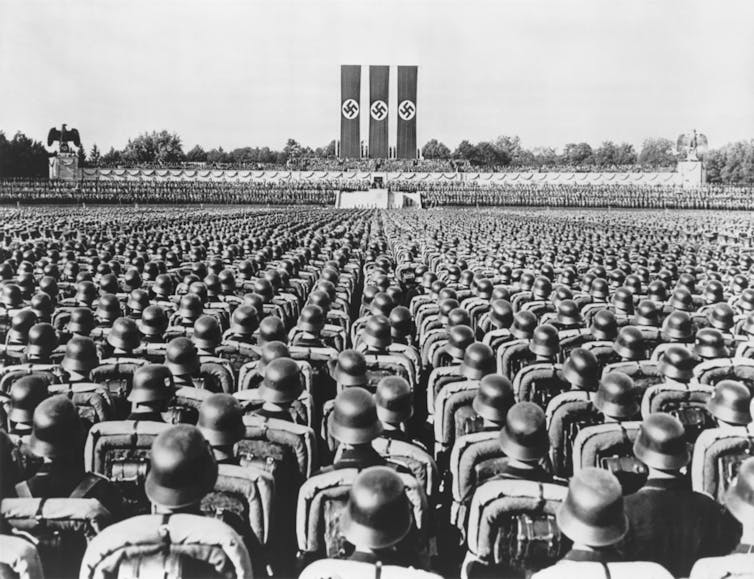
Nazi Germany drew on myth, to ruinous effect. Shutterstock

For Blumenberg, prefiguration lends mythical legitimacy to decisions that lack rational justification. Hitler’s ruinous comparisons between himself and figures such as Frederick the Great and Napoleon are the central case study used by Blumenberg to illustrate this theory.

How Boris deploys it

Johnson understands prefiguration. He knows the most significant episode in recent British history is victory over Germany in World War II, and that its “sacred” protagonist is Winston Churchill. Johnson’s Churchill biography of 2014 is a study in prefiguration, in which he presents himself as the heir to Churchill’s legacy. In it, Johnson wrote that among Churchill’s many sayings “a text will be found to … validate some course of action – and that text will be brandished in a semi-religious way, as though the project had been posthumously hallowed by Churchill the sage and wartime leader.”

During the Brexit campaign, Johnson made precisely this rhetorical move. The European Union, he wrote in the Telegraph newspaper in May 2016, is an attempt to create a European superstate “just as Hitler did”. By contrast, Churchill’s “vision for Britain was not subsumed within a European superstate”.

These irresponsible comparisons between the EU and Nazi Germany were criticised at the time, even by some of Johnson’s fellow Tories. But the message cut through. Rational arguments for remaining in the EU were trounced by the campaign to “Take Back Control”. When combined with Johnson’s references to Churchill and World War II, this slogan allowed Leave to command the emotional terrain of political myth, reminding voters of their nation’s heyday, when the British Empire was still intact.


Read more: Three issues Boris Johnson’s new government must tackle – none of which is Brexit


The mastermind of that campaign, Dominic Cummings, is now leading the team in 10 Downing Street. As a potential election looms, this raises troubling questions for Johnson’s opponents. Is rational argument enough to defeat political myth? Or must Remain also come up with a captivating myth to communicate the rational grounds for staying in the EU if that is to ever happen? Are rationality and myth even compatible?

Considering these problems requires an appreciation of the rhetorical power of political myth, and in this Blumenberg can help us.

Angus Nicholls, Professor of Comparative Literature and German, Queen Mary University of London

This article is republished from The Conversation under a Creative Commons license. Read the original article.

New BHC Prize: The Martha Moore Trescott Award

The Martha Moore Trescott Award (honoring Paul Uselding, Harold F. Williamson, Richard C. Overton, Alfred  D. Chandler, and Albro Martin)

The Business History Conference is delighted to announce the establishment of a new prize, The Martha Moore Trescott Award. The prize, generously funded by a bequest from the estate of the late Martha Moore Trescott, will be awarded to the best paper at the intersection of business history and the history of technology presented at the annual meeting of the Business History Conference. The award honors pioneering scholars Paul Uselding, Harold F. Williamson, Richard C. Overton, Alfred D. Chandler, and Albro Martin. Martha Moore Trescott was herself a pioneering member of the BHC and published extensively, particularly on the role of women in science and engineering, while she worked in academic administration for several universities. The prize will be for the amount of $500.

Criteria and eligibility:

The BHC will establish a prize committee of three under the terms set out in the by-laws. The prize will be awarded on the basis of the written version of a paper to be presented at the annual meeting. Those wishing to be considered for the prize must indicate so at the time of submitting their original proposal for the meeting. Self-nominating scholars must also provide the written paper to the Chair of the committee not less than one month before the annual meeting. Though the prize will be awarded on the basis of the written paper, candidates must attend the meeting and present their work. Scholars who are eligible for the Kerr Prize may also enter the Trescott Award. There are no other restrictions on eligibility.

Written papers should be no longer than 4,000 words (exclusive of notes, bibliography, appendices, figures and illustrations).

CHORD conference

CHORD Conference: ‘Retailing and Distribution in the Nineteenth Century’

by Laura Ugolini

The 2019 CHORD conference on ‘Retailing and Distribution in the Nineteenth Century’ will take place at the University of Wolverhampton on September 10, 2019

The programme, together with abstracts, registration details and further information, can be found at:
https://retailhistory.wordpress.com/2019/06/09/2019/


The programme includes:

Patricia Lara-Betancourt, Kingston University
Retailing the Modern Home: The Large Furniture and Furnishing Firm in London West End, 1890-1914

Judith Davies, University of Birmingham
A large family of small shopkeepers: the Wood family of Dudley in the middle decades of the nineteenth century

Massimiliano Papini, Northumbria University
‘Veritable fairyland’: Mikado Bazaar in Sunderland and the commodification of Japanese culture in the North-East of England, 1873-1903

Nick Gray, University of Wolverhampton
Retail credit in the late nineteenth century: the case of Hall and Spindler of Leamington Spa

Lorenzo Avellino, University of Geneva
Discipline of Trade, Discipline of Work: Embezzling and Middlemen in the Silk Fabrics of Lombardy (1800-1810)

Johanna Wassholm and Anna Sundelin, Åbo Akademi University
Practices and morality in the late nineteenth century human hair trade. Finland as part of transnational flows of goods

James Inglis, The University of St Andrews & National Museums Scotland
‘A Machine to Supersede the Pen?’ Typewriter Retail in Scotland, 1875 to 1900

Simon Constantine, University of Wolverhampton
Licensing Itinerant trade and the fight against ‘Gypsies’ in Germany (1871-1914)

Ruth Macdonald, Salvation Army International Heritage Centre
Retail therapy? The role of trade in Salvation Army rescue work for women

Lesley Steinitz, University of Cambridge
Creating a national brand: advertising Dr Tibbles Vi-Cocoa to consumers and retailers

Sophie Clapp, Boots Archive
“What’s in a name?” – The significance of brand positioning in the early development of Boots the Chemists, 1880-1900

Nicholas Alexander, Lancaster University, Anne Marie Doherty, University of Strathclyde, James Cronin, Lancaster University
Market-Mediated Authenticity and the Emergence of Modern Branding Practices: Liberty of London, 1875-1900

The conference will be held at the University of Wolverhampton, Wolverhampton City Campus.

The fee is £20.

Registration is via the University of Wolverhampton’s e-store, at:
https://www.estore.wlv.ac.uk/product-catalogue/conferences-events/faculty-of-social-sciences/chord-conference-retailing-and-distribution-in-the-nineteenth-century/chord-conference-retailing-and-distribution-in-the-nineteenth-century

Or see the conference web-pages, at:
https://retailhistory.wordpress.com/2019/06/09/2019/

Or contact Laura Ugolini, at: L.Ugolini@wlv.ac.uk

Prof. Laura Ugolini
Professor of History

Dept. of History, Politics, War Studies
Faculty of Social Sciences
Room MH124
Mary Seacole (MH) Building
University of Wolverhampton
Wolverhampton
WV1 1LY

Find out more about CHORD events: https://retailhistory.wordpress.com

AOM PDW – Stigma research

Developing Stigma Research: Exploring How Our “Lenses” Affect Our Research

https://my.aom.org/program2019/SessionDetails.aspx?sid=10944

Building on our previous PDWs, this PDW aims to help researchers to develop their research projects about stigma and identify opportunities for research. Particularly, we hope to contribute to a better understanding of stigma’s role in influencing identities, organizations, professions, and fields.

Overall, this PDW consists of three components:

-(1) an introduction that defines the topic and provides an overview of recent work.

-(2) Thematic roundtables, each facilitated by 2-3 well-known scholars, which will also focus upon “challenges” that researchers are experiencing in positioning, conceptualizing, and publishing their work. Roundtables will last 60 minutes and have a maximum of 6 participants per table.

-Finally, there will be (3) a panel in which prominent experts, Bryant Hudson, Glen Kreiner, and Paul Tracey, will present their reflections on how their theoretical lenses shape their topics, methods, and findings on stigmatized actors. The organizers will then facilitate a discussion on how our lenses and empirical choices as researchers shape, or should shape, our research, before opening the discussion to the group.

You need to pre-register for this PDW. Please contact the workshop organizers at aomstigma@gmail.com to obtain the approval code. To pre-register you need to submit a 1-2 page document with an abstract of a project and a challenge statement that outlines the issue that you would like to discuss at your roundtable. The deadline to register online is August 2, 2019.

Christian Hampel
Assistant Professor of Entrepreneurship and Strategy

Imperial College Business School
South Kensington Campus, London SW7 2AZ, UK

PDW AOM on Organizational Mnemonics

There are still some spots available for the paper development workshop roundtables on Organizational Mnemonics at AOM Aug 9 2019 10:15AM – 12:15PM

  If you have an extended abstract (up to 750-words) that you would like to receive feedback from some leading researchers in the field, please let us know asap so we can include your submission in one of the roundtables.

  The details of the PDW are as follows.

Organizational Mnemonics: The ‘Historical Turn’ and the Research on Learning, Memory, and Ignorance

DATE & TIME
Friday, Aug 9 2019 
10:15AM – 12:15PM
LOCATION
Boston Marriott Copley Place, Grand Ballroom Salon CD

 Organizers

  • Diego M. Coraiola, University of Alberta
  • Maria Jose (Majo) Murcia, IAE Universidad Austral
  • François Bastien, University of Alberta
  • Fernanda Tsuguichi, University of Victoria

Panelists

  • Mary Crossan, Western University
  • Pablo Martin de Holan, Prince Mohammad Bin Salman College
  • Jukka Rintamäki, Loughborough University London
  • William M. Foster, University of Alberta
  • Gabrielle Durepos, Mount Saint Vincent University
  • Marcos Barros, Grenoble Ecole de Management

Discussant

  • Michael Rowlinson, University of Exeter

 Aims and Scope

The goal of this PDW is twofold. First, we want to bring together scholars from the three main traditions of thought within the field of organizational mnemonics. We use the concept of mnemonics as a reference to a broader field of inquiry than what is usually included within the research on organizational learning and knowledge management. We argue that the field organizational mnemonics focuses on theorizing about the past as an integral part of organizational life. In addition to the research on organizational learning and knowledge, we include as part of the field the communities interested in the study of collective memory and the uses of the past in organizations, as well as the research on ignorance, stupidity, forgetting-work, and ANTi-history.

So far, however, these communities have been as separate epistemic communities and have rarely engaged directly with one another. This PDW will provide an important forum to display the range of approaches that constitute the field of organizational mnemonics and presenting some of the multiple possibilities of research within and between approaches.

Format of the PDW

The PDW will comprise two parts:

 In the first part, a group of seasoned researchers will share their experience working in the field and present a view about the future of the research on organizational mnemonics. Pre-registration for the first part will not be required.

The second part will focus on providing feedback and career advice to PhD students and Early Career scholars. Participation in the second part of the PDW will require the pre-submission of an extended abstract (750 words). The participants will be assigned to roundtables with the panelists and other participants. They will all read each other abstracts in advance and will receive feedback from one another as well as from the panelists during the roundtables.

PDW Submission Requirements

Scholars interested in participating in the second part of the PDW and get feedback on their research should submit an extended abstract (up to 750-words) to be read in advance by members of the roundtable.

Please direct all inquiries regarding the PDW to Diego Coraiola coraiola@ualberta.ca or Majo Murcia mmurcia@iae.edu.ar.