Marie S Curie fellows at Aston Business School

Aston is currently looking for external researchers to work with on Marie Skłodowska-Curie Fellowships. The current deadline for applications is 14th September 2016, with the next call opening in April 2016.


Eligible Researchers

  • The Funder requires that the researchers shall be in possession of a doctoral degree or have at least four years of full-time equivalent research
  • At the time of the deadline for submission, they shall not have resided or carried out their main activity (work, studies, etc) in the country of their host organisation for more than 12 months in the 3 years immediately prior to 14th September

Preferred Researcher Profile

  • Experience suggests that successful researcher have strong CV’s, with 10+ strong publications (high- ranking, international journals) and a good range of experience (teaching, industry/non-academic, PhD supervision).

The Marie Skłodowska-Curie Individual Fellowships enable eligible applicants to come to Aston University for a period from 12 to 24 months; the aims are to undertake world class research, undertake career development, and transfer knowledge. If you have the time, read the Guide for Applicants, it will enable you to fully appreciate the aims and objectives of the scheme –  http://ec.europa.eu/research/participants/portal/doc/call/h2020/h2020-msca-if-2014/1600147-  guide_for_applicants_if_2014_en.pdf

If you are interested please contact Prof Stephanie Decker (s.decker@aston.ac.uk). Send a description of your potential theme, Aston host and a description of the potential project (please keep the description to no more than 250 words), accompanied by your full academic CV to r.knobbs@aston.ac.uk .

The current deadline is 14th September 2016. If you are interested you must send the requested documents by the end of July for this call.

Full program ESRC seminar 17 February 2016

ESRC Seminar Series: Historicising the theory and practice of organizational analysis

Seminar 4: Ethnography and Phenomenological Approaches

 17 February 2016, Alumni Club Room, Alliance Manchester Business School, Booth Street West, Manchester M15 6PB

Final programme and arrangements

0930-1000       Arrival and Refreshments

1000-1015       Welcome and Introduction

1015-1100       Alan McKinlay (Newcastle U): “Foucault and the archive”

1100-1145       Bill Cooke (York U): “The affect of the archive”

1145-1200       Coffee/Tea

1200-1245       Andrea Whittle (Newcastle U): “History-in-action”

1245-1330       Buffet Lunch

1330-1415       Andrea Bernardi (Manchester Metropolitan U): “Auto-ethnography”

1415-1500       Stephanie Decker (Aston U) “Archival ethnography”

1500-1515       Coffee/Tea

1515-1600       Lucy Newton (Reading U): “Corporate identity”

1600-               Discussion and Closing Remarks

Registration and attendance:  The workshop is basically “full” but we have been allocated a few extra free places and these will be allocated on a “first come first served” basis. A conference registration fee of £30.00 will be charged on additional places and this will include refreshments and buffet lunch.

Travel & accommodation: Expenses should be covered by participants (except speakers, whose travel and accommodation costs will be covered). Accommodation for speakers (for night of 16 February) is at the Pendulum Hotel, Sackville Street, Manchester, M1 3BB (note: the Pendulm Hotel is approximately 10 minutes’ walk from Manchester Piccadilly station and 10 minutes walk from Alliance Manchester Business School).  Workshop organisers will be in the lobby of the Pendulum Hotel at 0900-0915  on 17 February to walk delegates to AMBS (West Building).

Pre-conference dinner: A preconference dinner will be held for speakers and organisers at Evuna NQ, 79 Thomas Street, Manchester M4 1LQ.   The dinner is scheduled to start at 8pm.  The restaurant is in the “Northern Quarter” district of the city. Speakers and organisers will meet at 1930 in the lobby of the Pendulum Hotel and walk to the restaurant (weather permitting). Can anyone who has specific dietary requirements (vegetarian, vegan, diabetic, etc) please advise Nighat Din in advance.

Venue: The workshop will be held in the Alumni Club Room, Alliance Manchester Business School, Booth Street West, Manchester M15 6PB.  Alliance Manchester Business School is approximately 15 minutes walk from Manchester Oxford Road station (20 minutes from Manchester Piccadilly). See University of Manchester website for details. The entrance to AMBS is the main door (West Building) on Booth Street West (note: there is currently current building work in operation connected with the refurbishment of the School but this does not affected access from Booth Street West).

For further enquiries: Please contact the conference administrator (Nighat Din: nighat.din@mbs.ac.uk] or members of the organizing team: John Hassard (john.hassard@mbs.ac.uk) and Damian O’Doherty (damian.odoherty@mbs.ac.uk), both at Manchester Business School); Stephanie Decker (s.decker@aston.ac.uk) at Aston Business School; or Mick Rowlinson (m.rowlinson@qmul.ac.uk) at Queen Mary University London.


Dean’s scholarships for PhD at Aston Business School

This year there will be a number of Dean’s scholarships available for doctoral study at Aston Business School (ABS). The scholarship offers £17.000 for 3 years + cover of PhD fees (same condition for Home/EU and Overseas students).[1] The deadline for applications is March 14th 2016.

If you are interested in doing a PhD in organizational history, please contact Prof Stephanie Decker, s.decker@aston.ac.uk.

Application Criteria for Dean’s Scholarship

All applicants for the Dean’s Scholarships must meet the standard entry requirements for the PhD programme at the Aston Business School:

  • UG Degree 2:1 or above
  • MSc Degree – 65% in taught and dissertation elements.
  • English Language requirements (TOEFL 101, IELTS 7)

Additionally, all applicants must have:

  • GRE/GMAT[2]  at 70% (i.e. this means that the applicant has obtained a better score than 70% of all tested participants).

[1] Teaching is not required as a condition of this scholarship. All PhD students will be able to undertake paid teaching work should they wish to, where available, subject to a number of conditions.  Students can only undertake teaching on successful completion of their Qualifying Report and must take the Aston Certificate: An Introduction to Learning and Teaching in HE. To ensure that research time is not affected, the total amount of teaching and/or research assistance hours a PhD student can undertake will be limited to 110 hours per year and will be agreed and monitored by the RDP office.

[2] GRE/GMAT is an independently administered test that assesses quantitative, analytical and verbal skills.  This test allows for a rigorous degree of bench marking between applicants. The minimum requirement of 70% applies to each section. For candidates having additional English Language requirements (TOEFL/IELTS), these results will count instead of the verbal reasoning section.

The applicant must provide evidence of:

  • UG Degree
  • MSc Degree
  • 2 comprehensive academic references
  • GRE/GMAT Score
  • Language (if required)
  • Publications (if relevant)

For more details, please see: http://www.aston.ac.uk/aston-business-school/programmes/research/phd-in-management/


New Paper Alert: Using history in the creation of organizational identity”

Cross-posted from The Past Speaks…

andrewdsmith's avatarThe Past Speaks

AS: I would like to draw your attention to an important new paper in the forthcoming Special Issue: Re-visiting the Historic Turn 10 years later: Current Debates in Management and Organizational History

Mike Zundel (University of Liverpool Management School), Robin Holt (Copenhagen Business School) & Andrew Popp (University of Liverpool Management School), “Using history in the creation of organizational identity.”

Abstract: Organizations frequently draw on history as a resource, for instance when attempting to establish or maintain identity claims. However, little has been done to review the advantages and problems of such use of history and it is not clear how using history impacts on the appreciation of history itself and, ultimately, on the insights that may be gained when engaging with the past. To begin to address these questions we distinguish two related uses of history as a resource for organizational identity: as a means of committing external audiences and, as…

View original post 107 more words

ERSC seminar: Ethnography & phenomenological approaches

The next ESRC seminar will take place at Alliance Manchester Business School, 17 February 2016.

Program

0930-1000       Arrival and Refreshments

1000-1015       Welcome and Introduction

1015-1100       Alan McKinlay (Newcastle U): “Foucault and the archive”

1100-1145       Bill Cooke (York U): “The affect of the archive”

1145-1200       Coffee/Tea

1200-1245       Andrea Whittle (Newcastle U): “History-in-action”

1245-1330       Buffet Lunch

1330-1415       Andrea Bernardi (Manchester Metropolitan U): “Auto-ethnography”

1415-1500       Stephanie Decker (Aston U) “Archival ethnography”

1500-1515       Coffee/Tea

1515-1600       Lucy Newton (Reading U): “Corporate identity”

1600-               Discussion and Closing Remarks

VIU Summer School Responsible Capitalism

VIU Summer School Responsible Capitalism: Strategy, Governance and Finance

Venice International University
June 6 – 10, 2016
Isola di San Servolo, Venice

 The school is organized by Venice International University with the participation of professors from Università Ca’ Foscari Venezia, Columbia University, Henley Business School, IESE Business School, University of Lausanne and University of Reading.
The program is designed to promote research and education on  the future of capitalism in the light of current research in economic sociology, strategy, organization theory, finance, history and philosophy. The school will provide a unique opportunity for researchers in their early stage of their carrier to interact with prominent scholars in the field and develop their own research program.

Who is it for:
Applications are welcome from current Ph.D. students, research master’s students (e.g. MPhil students), post-doc researchers in Management, Strategy, Organization Theory, Finance, Economic Sociology, and related disciplines from universities worldwide.

Program structure:
The 5 day program will combine lectures, seminars, and developmental workshops.
In the morning, the state of the art in research will be discussed along with selected articles, including the presentations of faculty’s own research work on the topics.
In the afternoon, participants will be invited to present their research ideas and, being guided by a senior scholar, they will develop their research projects.
The program starts on Sunday evening with a welcome reception and ends on Friday afternoon with a site visit in Venice.

Program theme:
The growing gap between rich and poor, the social and environmental side effects of production and a regulatory vacuum around multinational production networks have forced new critical debate  on our economic system. The School will therefore investigate sustainable capitalism from different angles: It will start by analyzing the ever more “postnational” constellation of capitalism, the potential roles and responsibilities of corporations in this changing societal context and sustainable corporate strategies. It will discuss the integration of environmental, social and governance factors (ESG) in traditional finance portfolio management and the concept of responsible investment. Finally, It will analyze one of the key complications of sustainability, namely the fact that it requires interdependent decisions and actions of multiple agents acting in a distributed environment. This circumstance alters both decision-making and the strategy implementation processes, and challenges the current governance and management conceptual toolkit available to scholars and practitioners.

Faculty

Giovanni Favero, Università Ca’ Foscari Venezia
Fabrizio Ferraro, IESE Business School
Andreas Hoepner, Henley Business School
Guido Palazzo, University of Lausanne
Josh Whitford, Columbia University
Francesco Zirpoli, Università Ca’ Foscari Venezia.

Application procedure and costs

The Program will admit 15 student participants.

There will be no participation fee and VIU will cover also accommodation at San Servolo Island campus and meals. Student participants will be responsible for covering their own travel expenses to and from Venice and local transportation. Complete information about the Program, credits, application procedures and form is available at  http://www.univiu.org/shss/seminars-summer-schools/  responsible-capitalism

For further information:

elisa.carlotto@univiu.org

Application deadline:

April 3rd 2016
admitted candidates will be notified by April 15, 2016.

Venice International University

Isola di San Servolo
30100 Venice
Italy
T +39 041 2719511
F +39 041 2719510
E www.univiu.org

Detailed Program

Sunday, June 5
Welcome dinner

Monday, June 6

Morning: Guido Palazzo, University of Lausanne

On the first day, we will set the scene with a discussion of some societal transformations that are currently changing the context of managerial decision-making. We move from a nation state world to a postnational constellation in which the roles of corporations and the conditions of their legitimacy get renegotiated. New strategic concepts from political Corporate Social Responsibility (CSR) to Creating Shared Value will be discussed.

Afternoon: workshop with Guido Palazzo

Tuesday, June 7

Morning: Andreas Hoepner, Henley Business School

Day two will explore responsible investing from a finance perspective. The discipline of finance has only recently started to study this investment practices closely, but recently many authors have started to engage with this challenge from both a theoretical and empirical point of view. We will provide an introduction to this topic from a finance perspective, and lead discussions on the most interesting recent papers on the topic.

Afternoon: workshop with Andreas Hoepner

Wednesday, June 8

Morning: Fabrizio Ferraro, ISE Business School and Laura Berry, Former Executive Director, Interfaith Center on Corporate Responsibility (ICCR).

On day three, we will continue to discuss the emergence of responsible investing, but from a different disciplinary perspective: organization theory and economic sociology. Organization theorists and economic sociologists have been studying the fi           sector for years, but in the last decade, perhaps due to the increasing centrality of fi

markets and the 2008 fi           crisis, the breadth and depth of our work in this area has grown exponentially. From this perspective, we will discuss the emergence and diffusion of novel forms of investing, practices, and organizational forms in the fi          sector, and their consequences for organizations outside of the fi           sector. Also we will focus on the practice of shareholder engagement, and its implications for social movement theory, corporate governance, and more broadly the role of corporations in society.

Afternoon: workshop with Fabrizio Ferraro

Thursday, June 9

Morning: Josh Whitford, Columbia University
and Francesco Zirpoli, Università Ca’ Foscari Venezia

On day four, we will discuss the evolution of decision-making in global companies. We will give particular attention to the implication of the fact that decision makers are often “multiply embedded” in organizations, in places, in informal social

networks, in more formal associations, and so on. Interdependent decisions and actions of multiple agents acting in a distributed environment are profoundly altering both decision making and the strategy implementation processes in ways that demand some rethinking of the governance and management conceptual toolkit. Sociological and organization theories, including theories of organizational politics, social movements, relational embedding and cognitive framing will be presented, discussed and applied to understand the conditions under which global firms confront with environmental, social and governance decisions.

Afternoon: workshop with Josh Whitford and Francesco Zirpoli

Friday, June 10

Morning: Josh Whitford, Columbia University

The workshop will close with a discussion of the interplay between managerial decision-making and state policymaking with an

eye towards questions raised across discussions had during the week. Those discussions will have challenged participants to think critically about some of the limits to a reliance just on the state

to “fix” the gap between rich and poor, or to regulate the social and environmental side effects of production, given the mobility of capital, tax competition, and so on. This last day will turn the question around in a discussion that aims to force participants to think critically also about the limits that inhere in efforts to

“responsibilize” the corporate sector in the absence of efforts also to rethink and remake the regulatory strategies of state and/or supra-national governing bodies.

Afternoon: itinerant workshop with Giovanni Favero, Università Ca’ Foscari Venezia

We will visit the Scuola Grande di San Rocco, using it as an occasion to confront the debate on the peculiarities of economic governance in the Republic of Venice. Some scholars have interpreted it as a model case of socially responsible capitalism, whilst others have highlighted its structural inequalities and inefficiencies. Putting such experience and its interpretations in time into an historical perspective allows shedding light on the transformations and variations of concepts as fairness, reciprocity and responsibility.

Call for applications:Junior Scholars Forum In Civil Society, the Nonprofit Sector, and Philanthropy

2016 Call for applications 

Junior Scholars Forum In Civil Society, the Nonprofit Sector, and Philanthropy

pacscenter.stanford.edu/junior-scholars-forum

June 15-17, 2016

Berlin Application Deadline: February 22, 2016

The annual Stanford PACS Junior Scholars Forum brings together newer researchers, including graduate students, postdoctoral fellows, and junior faculty, working in the general areas of civil society, the nonprofit sector, and philanthropy to increase the sense of intellectual community and enhance the overall quality of research. The goal of the forum is to highlight exciting work being done by junior scholars and to contribute to the development of their scholarship. Background In summer 2014 the Stanford Center on Philanthropy and Civil Society hosted its inaugural Junior Scholars Forum, a gathering that brought together newer researchers with senior scholars for two days of presentations, intensive discussions and socializing. The forum highlighted exciting work being done in the fields of philanthropy and civil society. The 11 junior scholars selected were drawn from a competitive pool of applications and came from political science, economics, sociology, anthropology, and other disciplines. In 2015, the second forum was held featuring 9 junior scholars from an equally broad range of disciplines. About the Junior Scholars Forum in 2016 We are excited to announce that the 2016 JSF will be convened in Berlin, Germany June 15 – 17th, 2016 at the Hertie School of Governance. Applicants who are selected will receive funding for travel, accommodation, and eligible travel expenses. Each paper selected will have two discussants, one an established scholar working in the area of research, the other a graduate student or a postdoctoral fellow also working on the topic. The forum will provide ample time for discussion and meals together so that we can begin build an intellectual community that we hope will last beyond the event. We are open to a wide variety of topic areas.
Without limiting submissions to items on this list, here is description of some themes that we are particularly interested in and in which there is active work under way at Stanford:

  • The expansion of global governance, particularly transnational organizations and their causes and impact
  • The role of social movements and advocacy groups in policy reform or revolt efforts at measuring effectiveness in the social sector
  • The relationship between philanthropy and democracy
  • New organizational forms, ranging from hybrids to b corps, from cooperatives to for-profits with a purported social mission; corporate social responsibility; impact investing
  • Novel approaches to analyzing the role of social capital in civil society
  • New open models of public media and knowledge, ranging from journalism to encyclopedias to scientific production

Submission details

We welcome submissions by graduate students and postdoctoral fellows as well as junior faculty. We want to cast a wide net and welcome submissions from a robust variety of disciplines and professional schools. The committee will favor solo-authored papers from junior scholars, and papers that examined civil society and philanthropy through new lenses. Please submit a research paper by email to Sam Spiewak, Program Manager, at spiewak@stanford.edu. Please make your subject line: “Junior Scholars Forum.” There are no specific length or formatting requirements for the paper and advanced drafts will be accepted along with published papers. We will select eight to eleven papers for the 2016 forum. The “we” includes the faculty co-directors of the Center on Philanthropy and Civil Society, other Stanford Faculty, and several distinguished members of the larger academic community who will join us at the June forum. We will notify all applicants of the outcomes by early April. Funding will be provided to cover travel expenses and accommodations will be arranged in Berlin.

For more information, contact Sam Spiewak (spiewak@stanford.edu).

Applied microhistory: A workshop.

Applied microhistory: A workshop.

Ecole des Hautes Etudes en Sciences Sociales, Paris
Tuesday, 15 March 2016.
9 am – 2 pm

As time puts things into perspective, the heated and sometimes misleading historiographical debates of the1970s and 1980s on micro-history and its focus on small subjects seem to fade away. Yet in the meantime historical micro-analysis has emerged as a useful method to approach a very diverse set of questions in different fields of social sciences and humanities.
Micro-analysis focuses on the reduction of scale as an instrument to answer theoretical general questions, maintaining a dynamic tension between ‘emic’ and ‘etic’ perspectives. In so doing, it offers a logical procedure to infer general considerations from specific cases, regardless of their statistical representativeness. At the same time, this approach implies a contingent view of the relationship between agency and structure, highlighting the creativity of the former and the complexity of the latter.
This workshop aims at discussing the contribution of micro-analytical historical approaches to research in different fields, from the most classical focus on local communities to the challenge of studying at micro level global connections and institutions, as well at the organizational level. Contributors are invited to address the
methodological issues implied in the use of a micro-analytical approach with reference to a diverse range of research fields.

Please send any enquiries to Giovanni Favero (Università Ca’ Foscari Venezia) – gfavero@unive.it
Papers to be discussed (provisional titles):
Roser Cusso (Université Paris 1 Panthéon Sorbonne), Micro-history and the IO: the case of LoN’s minorities section.
Stephanie Decker (Aston Business School), Mothership reconnection: Microhistory and institutional work compared.
Giovanni Favero (Ca’ Foscari University of Venice), Putting micro-history at work: Exception and norm, observation and experiment.
Per Hansen (Copenhagen Business School), A sense-making approach to the response of central banks to the Austrian finacial crisis of 1931.
Miki Sugiura (Hosei University), Maintaining polycentric cities under de-urbanization: Local merchants’ real estate strategies in Bolsward, Friesland.
Discussants:
Monica Martinat (Université Lumière Lyon 2), Simona Cerutti (EHESS Paris), Andrew Popp (University of Liverpool), Francesca Trivellato (Yale University)
References:
Decker, Stephanie (2015) Mothership reconnection: Microhistory and institutional work compared. In T.G Weatherbee, P.G. McLaren, & A.J. Mills (Eds.), The Routledge Companion to Management and Organizational History (pp. 222-237). London: Routledge.
Fellman, Susanna & Rahikainen, Marjatta (Eds.) (2012) Historical Knowledge: In Quest of Theory, Method and Evidence. Newcastle Upon Tyne: Cambridge Scholars Publishing.
Magnússon, Sigurour G. & Szijártó, Istvan M. (2013) What is Microhistory? Theory and Methods. London: Routledge.
Trivellato, Francesca (2011). Is there a future for Italian microhistory in the age of global history? California Italian Studies Journal, 2(1).

Report on the Digitisation of Cultural Heritage

Love it or loathe it, digitisation and digital humanities are becoming and increasingly important area for anyone interested in historical research on organizations. Yet the report by eNumerate, formerly an EU funded project aimed at creating statistical data about the digitization, of cultural heritage in Europe, shows that there is still a long way to go for most archives:

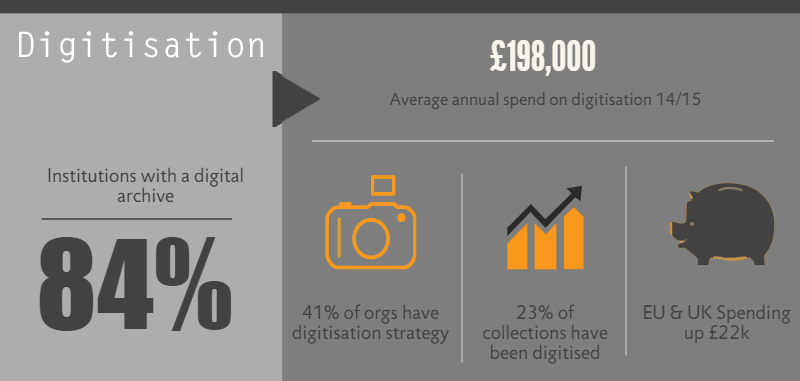
“On average 23% of European collections have been digitised, with Museums leading the way with the highest proportion (31%) up from 24% in the 2014 survey (Core Survey 2- CS2). However at the other end of the scale, only 13% of record office/archive collections and 19% of library collections have been digitised. This is possibly down to the vast amount of records these institutions hold, which could result in a longer digitisation process.”

As this infographic shows, digitisation remains a major area that the UK government and the EU are investing in. Yet the impact this is likely to have on research practices or the availability of documents from private organization archives remains unclear.

Infographic: Digitisation landscape in 2015 from eNumerate

You can read the summary and the full report here: eNumerate Digitisation in Cultural Heritage 2015 : Key findings | TownsWeb Archiving.