MOH SI: Imperialism & Coloniality in MOH

Management & Organizational History

Special issue call for papers:

Imperialism and Coloniality in Management and Organization History

Deadline: 16 December 2016

Management & Organizational History

The ongoing dialogue about the role that history can play in the formation of organization theory, and the role that organization theory can and does play in management and organization history (Maclean, Harvey, and Clegg 2015; Rowlinson, Hassard, and Decker 2014; Taylor, Bell, and Cooke 2009; Clark and Rowlinson 2004) should enjoinder greater engagement with areas where historians have long engaged in theoretical work. Classical theories of imperialism (Hobson 1902; Lenin 1999; Schumpeter 1951), historiographical theories of imperialism (Cain and Hopkins 2002; Gallagher and Robinson 1953; Jones 1980; West 1973), and post-colonial theory that explores the operation of capitalism (for example, Chibber 2014; Quijano 2007; Moraña, Dussel, and Jáuregui 2008) are all theory-sets that draw heavily on historical analysis. The already rich relationship between history and theory in these connected fields provides an opportunity to explore the contribution that management and organization history can make to both the theories and history of imperialism and coloniality, and how a reflection on these topics can provoke a richer and theory-informed understanding of how management and organizations replicate and form circuits of power–globally and locally.

In a contribution to the growing literature on coloniality, Aníbal Quijano writes that

In the beginning colonialism was a product of a systematic repression, not only of the specific beliefs, ideas, images, symbols or knowledge that were not useful to global colonial domination, while at the same time the colonizers were expropriating from the colonized their knowledge, specially in mining, agriculture, engineering, as well as their products and work. The repression fell, above all, over the modes of knowing, of producing knowledge, of producing perspectives, images and systems of images, symbols, modes of signification, over the resources, patterns, and instruments of formalized and objectivised expression, intellectual or visual. (Quijano, 2007, p.169).

The historical and contemporary claims made by Quijano that relate to management and organization (for instance, the simultaneous and ongoing imposition and expropriation of socio-economic knowledge) and its express linkage to business activities, resonates with the business history literature on the role that corporations have played in the process of imperialism in “informal” spheres, in particular in Latin America (for example, the classic work of Christopher Platt. See Platt 1977 as well as Jones 1980, and Miller 1999). While there have been recent contributions to that have reflected on the use of knowledge and organizational learning in the creation of colonial business activity (Mollan 2009) and the continuity of management practices from the colonial period to the present (Cooke 2003) there remains a gulf in knowledge of how business–and managerial practices of firms and other international organizations–created and sustained the social and economic relationships described by the writers on coloniality and imperialism. The methods of coercion, systemic integration, management control, and knowledge, remain largely opaque at the organizational level. Nevertheless, the continuity of these practices is present in what Bobby Banerjee has described as ‘necrocapitalism’, a contemporary form of colonialism; the power of corporations ‘to create lifeworlds and deathworlds in the contemporary political economy’ (Banerjee 2008, 1542). If this is so, then a fuller understanding of imperialism and coloniality in management and organization history will have much to reveal about international economic relations, social and economic development, enduring inequalities, and managerial and organizational behaviour in the liminal space between the ‘developed’ and ’emerging’ economies however considered with reference to period and place.

Topics might include but are not limited to:

  • The absorption and co-option of knowledge from colonized peoples into the organization(s) and management of empire
  • How management and organization perform agency and create structure in imperial and post-colonial contexts
  • Management and organization historical studies that explore classical, historiographical and post-colonial theories of imperialism and coloniality
  • New management and organization theories of imperialism and coloniality
  • Organizations as sites of contestation and liminality in imperial and colonial encounters
  • Management and organization as acts of colonial violence
  • The relationship between business, management, organization and (under)development in imperial and post-colonial periods
  • Management and organization as processes, and organizations as institutions, in the transmission of imperial power
  • Managers as colonial elites; colonial elites as managers
  • The development of management thought and its relationship to (neo)imperial ideas
  • Slavery and forced labour in the management and organization history of empire
  • Representations of empire in corporate history
  • Corporate archives as archives of imperialism
  • The colonial heritage of multinationals

References

Banerjee, Subhabrata Bobby. 2008. “Necrocapitalism.” Organization Studies 29 (12): 1541–63.
Cain, Peter J., and Anthony G. Hopkins. 2002. British Imperialism: 1688-2000. London: Pearson Education.
Chibber, Vivek. 2014. Postcolonial Theory and the Specter of Capital. Verso Books.
Clark, Peter, and Michael Rowlinson. 2004. “The Treatment of History in Organisation Studies: Towards an ‘Historic Turn’?” Business History 46 (3): 331–52.
Cooke, Bill. 2003. “The Denial of Slavery in Management Studies.” Journal of Management Studies 40 (8). Blackwell Publishing Ltd.: 1895–1918. doi:10.1046/j.1467-6486.2003.00405.x.
Gallagher, John, and Ronald Robinson. 1953. “The Imperialism of Free Trade.” The Economic History Review 6 (1). Wiley Online Library: 1–15.
Hobson, John Atkinson. 1902. Imperialism: A Study. Vol. 3. London.
Jones, Charles. 1980. “‘Business Imperialism’and Argentina, 1875-1900: A Theoretical Note.” Journal of Latin American Studies 12 (2). JSTOR: 437–44.
Lenin, Vladimir Ilʹich. 1999. Imperialism: The Highest Stage of Capitalism. Resistance Books.
Maclean, Mairi, Charles Harvey, and Stewart R Clegg. 2015. “Conceptualizing Historical Organization Studies.” Academy of Management Review.
Miller, Rory. 1999. “Informal Empire in Latin America.” Winks, Robin W., The Oxford History of the British Empire 5.
Mollan, Simon. 2009. “Business Failure, Capital Investment and Information: Mining Companies in the Anglo-Egyptian Sudan, 1900–13.” The Journal of Imperial and Commonwealth History 37 (2): 229–48.
Moraña, Mabel, Enrique D Dussel, and Carlos A Jáuregui. 2008. Coloniality at Large: Latin America and the Postcolonial Debate. Duke University Press.
Platt, Desmond Christopher Martin. 1977. Business Imperialism, 1840-1930: An Inquiry Based on British Experience in Latin America. Oxford: Clarendon Press.
Quijano, Aníbal. 2007. “Coloniality and Modernity/rationality.” Cultural Studies 21 (2-3). Taylor & Francis: 168–78.
Rowlinson, Michael, John Hassard, and Stephanie Decker. 2014. “Research Strategies for Organizational History: A Dialogue between Historical Theory and Organization Theory.” Academy of Management Review 39 (3): 250–74.
Schumpeter, Joseph A. 1951. The Sociology of Imperialism. Meridian Books.
Taylor, Scott, Emma Bell, and Bill Cooke. 2009. “Business History and the Historiographical Operation.”Management & Organizational History 4 (2): 151–66..
West, Katharine. 1973. “Theorising about ‘imperialism’: A Methodological Note.” The Journal of Imperial and Commonwealth History 1 (2): 147–54.

Submission Instructions

Informal enquiries to the editors of the Special Issue are welcome:

The York Management School
University of York
Freboys Lane
Heslington
York
United Kingdom
YO10 5GD

Paper development workshops

To support the development of papers for this special issue, there will be two opportunities for intending authors to present and develop their work.

The Management History Research Group Annual workshop will be held in Sheffield on Tuesday 12 and Wednesday 13 July 2016. Panels relating to the Special Issue will be held at the workshop. Further details can be found at the web-link below:

http://mgt-hist.org/index.php/mhrg-2016-sheffield/

There will be a further one-day PDW held in the Autumn of 2016, details of which will be advertised in due course.

Deadline for article submissions: Friday 16 December 2016

Editorial information

ESRC Nostalgia Seminar Report

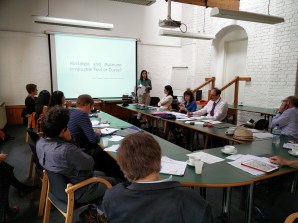
The fifth seminar in ESRC funded series on organizational history took place in a rather damp Birmingham on Wednesday 15th June. With the key theme of the day being Nostalgia, one might have forgiven the delegates a wistful look back to the June days of their past. Nonetheless, sprits were high despite the weather and our off-campus location alongside the canals of post-industrial Digbeth provided a fitting setting for the day’s programme.

IMG_7293

The first speaker for the day, Yannis Gabriel (University of Bath), initiated proceedings with a fascinating look at the role of nostalgia as a supporting feature of right-wing ideology. Moving away from his previous perspectives on nostalgia as a relatively benign phenomenon, the research instead focuses on those times where its existence can be leveraged for the aggressive promotion of a return to a past seen as better. Based on this, Yannis argues that nostalgia fuels authoritarian ideologies and movements by constructing the past in mythical terms that is free from the features of modern society that such groups see as undesirable.

IMG_7294

Following on from this, Constantine Sedikides (University of Southampton) shared his studies on the relevance of organizational nostalgia in work meaning. These looked at nostalgia as a factor in the reduction of employee turnover as well as observing the benefits it can provide to those suffering from burnout. Constantine goes on to suggest that where there are high levels of burnout, organizational nostalgia gives a rich source of meaning that is of benefit to employees work experience.

IMG_20160615_135434After lunch, Agnès Delahaye (Université Lumière Lyon II) started the afternoon session off with her presentation on usable pasts and the role nostalgia plays as a device for promoting an author’s version of a given history. The research centred on the writings and historiography  relating to the founding and development of New England. It is ultimately suggested that at times, history as a practice of caring about the truth, rather than a discourse, is idealistic.
IMG_20160615_142616

Eva Heesen’s (Leibniz Universität Hannover) followed with her research on the role of nostalgia within museum exhibitions and the
vistors’ use of such exhibitions as a form of mental escape. The talk highlighted the importance of balancing the educational role of museums with the need to provide an emotional experience to visitors. Her paper argues for nostalgia as escapism, which is seen as an indistinct longing for a recognizable but notably different version of reality.

IMG_20160615_153848

The final session by Marie MacLean (University of Bath) and Charles Harvey (Newcastle University Business School) focused on the uses of oral history and narrative interview techniques within business history. The research explores the use of such methods as way to capture subjective experience and in doing so looks at nostalgia of East Germans for the time before reunification with West Germany.

Thank you to all the speakers, session chairs and the delegates for the engaging and lively imput throughout the day. Announcements regarding the sixth seminar in this series will be published shortly and will be posted here on the Organizational History Network. For further information on the above presentations please follow this link – Fifth ESRC seminar series in Organizational History – Abstracts

ESRC seminar on “Nostalgia & History”

Nostalgia, Emotions & Organizational History

Wednesday 15 June 2016

The fifth seminar in our series will take place in Birmingham, hosted by Aston Business School at the Bond in Digbeth. Digbeth is a fitting place to consider the subject of nostalgia, as it is Birmingham’s post-industrial urban regeneration zone between the Bullring and the future HS2 station. It’s many empty warehouses and buildings have become venues for clubs featuring Northern Soul Dancing Classes, the Digbeth Dining Club, and alternative shops at the Custard Factory. Nearby is Birmingham’s oldest pub, the Old Crown, dating back to 1368.

If you would like to attend, please register for free here and enter the code ABS1.

The preliminary program so far:

0930-1000      Arrival and Refreshments

1000-1015       Welcome and Introduction

1015-1130        Yiannis Gabriel (Bath): “Organizational Nostalgia”

1130-1145       Coffee/Tea

1145-1230       Constantine Sedikides (Southampton): “Organizational Nostalgia Increases Work Meaning: The Moderating Role of Burnout”

1230-1330       Italian Buffet Lunch

1330-1415       Agnes Delahaye (Lyon 2): “Usable pasts and the anxieties of nostalgia: colonization and historiography in New England”

1415-1500       Eva C Heesen (Hannover): “Nostalgia and Museums: Invaluable Tool or Curse?”

1500-1530       Coffee/Tea and cake

1530-1615       Marie MacLean (Bath) & Charles Harvey (Newcastle): “Nostalgia, metaphor and the subjective understanding of historic identity transition”

1615-1645      Discussion and Closing Remarks

1645-1830      Drinks reception

As an ESRC funded seminar, attendance is free. Please register here and enter the code ABS1. If you have any questions, please contact the organizers: Prof Stephanie Decker (s.decker[at]aston.ac.uk) or Mr Adam Nix (nixaj[at]aston.ac.uk).

Event: Business history and digital records


Please accept our apologies for any cross-posting.

How will business histories be written from digital records?

MON, 9 MAY AT 09:30, EDINBURGH

Organized by:
Tim Gollins and Michael Moss

Free Event

The National Records of Scotland, in collaboration with the University of Glasgow’s Centre for Business History in Scotland (CBHS), is hosting a one day conference on the theme of using digital records for business history research. The conference will be held in Edinburgh on Monday 9th May 2016, and is an exciting opportunity for archivists, historians and technical experts with an interest in business records to meet and discuss the challenges and opportunities presented by the shift of records from the physical to the digital.

This one day conference will bring together interested parties from a variety of backgrounds, including businesses, archives, academics and technology. Speakers will present short papers aimed to provoke debate and discussion from panel members and delegates. The day will be an opportunity for collaboration and idea sharing and we anticipate some lively discussion! We hope that the event will produce a new network of professionals across a variety of disciplines, who will be persuaded to bid for funds to conduct further research.

Although the day will focus primarily on business records, the hope is that lessons learned from the business archive community will be used to inform wider debate about the issues surrounding use of digital records for research.

There will be four segments to the day, as follows:

Business archives: two archivists’ perspective

  • the paper world
  • the digital world
  • panel discussion

Business history: two historians’ perspectives

  • the paper world
  • the digital world
  • panel discussion

Digital technology: two experts from the field

  • insights and innovation
  • panel discussion

Conclusions: consortium speed dating exercise and funding streams.

The event is free to attend and tea/coffee and lunch will be provided. Places are limited so please book your ticket via Eventbrite soon.

WHEN: Monday, 9 May 2016 from 09:30 to 17:00 (BST)

WHERE: New Register House – 3 West Register Street, Edinburgh EH1 3YT, United Kingdom

Organiser:

Tim Gollins is Head of Digital Archiving at The National Records of Scotland and as programme director leads their Digital Preservation Programme. Prior to joining the NRS Tim was Head of Digital Preservation at the National Archives, where he led work on digital preservation and cataloguing. Tim was also a Director of the Digital Preservation Coalition for 6 years and is a member of the University of Sheffield I-School’s Advisory Panal.

Michael Moss has been a professor of archival science at Northumbria University since 2013 and holds a fellowship at the University of Melbourne’s e-Scholarship Research Centre. Michael was archivist of the University of Glasgow from 1974 until 2001, and research professor of archival science at the University of Glasgow between 2001 and 2013. He also has a long standing interest in business archives.

Please register here: https://www.eventbrite.co.uk/e/how-will-business-histories-be-written-from-digital-records-tickets-24394826583

Please contact Jo Dixon at Josephine.Dixon@nrscotland.gov.uk for further information.


Program PDW Historical Approaches to Entrepreneurship, March 31, 2016 Portland, OR

Supported by the CBS Rethinking History at Business School Initiative David Kirsch, Christina Lubinski, and Dan Wadhwani are hosting a Paper Development Workshop on Historical Approaches to Entrepreneurship Theory & Research. The workshop will take place on March 31, 2016, 9am-5pm; immediately before the BHC annual meeting and at the same location: the Embassy Suites by Hilton Downtown Portland, Room: Roy Yates (Lobby Level).

The program below shows an interesting mix of themes and scholars from entrepreneurship studies and history. Please get in touch with Christina Lubinski (cl.mpp@cbs.dk) if you are interested in reading any of the papers.

9:00 – 9:15 a.m.                    Welcome

9:15 – 10:15 a.m.                  Turning Points and Financial Innovation

Commentator: David Kirsch (University of Maryland, College Park)

“Creative Construction: The Importance of Fraud and Froth in Emerging Technologies,” Jonathan Coopersmith (Texas A&M University)

“Entrepreneurship, Financial Systems and Economic Development,” Steven Toms, Nick Wilson and Mike Wright (University of Leeds Business School and Imperial College London)

10:15 – 11:15 a.m.               Entrepreneurial Uses of History

Commentator: Roy Suddaby (University of Victoria)

“The Legacy of 20th Century Black American Entrepreneurs: Education and Entrepreneurial Self –Efficacy,” Carolyn Davis and Keith Hollingsworth (Morehouse College)

“Strategic and Institutional Uses of the Past by Family Philanthropic Foundations,” Ida Lunde Jorgensen (Copenhagen Business School) and Roy Suddaby (University of Victoria)

“An Entrepreneur’s Cathedral: Expressing and Preserving Founder Legacy in a Family Business. The Case of Fiberline Composites,” Ellen M. Korsager and Anders Ravn Sørensen (Copenhagen Business School)

11:15 – 11:45am                   Coffee Break

11:45 a.m. – 12:45 p.m.     Entrepreneurial Biographies Revisited

Commentator: Mads Mordhorst (Copenhagen Business School)

“Entrepreneurs as Actors: Biographical Approaches and the Analysis of Entrepreneurship,” Uwe Spiekermann (Goettingen University)

“Institutional Entrepreneurship and Ideological Rhetoric: Establishing the Global Hotel Industry” Mairi Maclean and Charles Harvey (Newcastle University Business School)

“Paran Stevens and the Birth of Hotel Entrepreneurship,” Daniel Levinson Wilk (Fashion Institute of Technology, New York)

12:45 – 2:15 p.m.                 Lunch

2:15 – 3:15pm                         History and Entrepreneurship

Commentator: Andrew Nelson (University of Oregon)

“What Entrepreneurial History Could Be and Why It Matters,” Dan Raff (Wharton School / University of Pennsylvania)

“Reconciling the JBV and the Past Futures Methodology: Towards a Synthesis and Research Methodology,” Andrew Smith (University of Liverpool) and Kevin Tennent (University of York)

3:15 – 3:45 p.m.                    Coffee Break

3:45 – 4:45 p.m.                    International Entrepreneurship and Institutional Change

Commentator: Geoffrey Jones (Harvard Business School)

“Born Global in 1850: A Historical Method for Understanding Entrepreneurs Across Time and Space,” Michael Aldous (Queen’s University, Belfast)

“Freeing the Market: Entrepreneurship and Institutional Change in Brazil, 1874-1904,” Kari E. Zimmerman and David L. Deeds (University of St. Thomas, St. Paul, Minnesota)

4:45 – 5:00 p.m.                    Concluding discussion

The purpose of this workshop is to provide scholars with developmental feedback on work-in-progress related to historical approaches to entrepreneurship and strategy, broadly construed. Our aim is support the development of historical research on entrepreneurship for publication in leading journals, including for the special issue of Strategic Entrepreneurship Journal. In addition to providing feedback and suggestions for specific topics, the workshop will address the commonly faced challenges of writing for a double audience of historians and entrepreneurship/management scholars, engaging entrepreneurship theory and constructs, and identifying the most valuable historical sources and methods in studying entrepreneurial phenomena.

Said BS TOPOS seminar with Martin Parker

TOPOS seminar with Martin Parker, Professor of Organisation and Culture from the University of Leicester, on Tuesday 31st May, 16.00-17.30, in the Boardroom of Said Business School, Oxford University.

If you are interested in attending, please contact Bethsheba McGill, bethsheba.mcgill@sbs.ox.ac.uk

Title: Daniel Defoe and the Bank of England: The Dark Arts of Projectors

 Valerie Hamilton and Martin Parker

Abstract:

Our paper tells the truthful story of how the Bank of England came into being. It is a story of buccaneers, treasure, random good fortune and sheer determination. This is an institution founded on risk, daring and imagination. Our tale is entangled with that of the early novel, in particular the fortunes of one Moll Flanders, an entrepreneur of sexual relations in the growing London market for capital in the early eighteenth century. These accounts are woven together with the life-stories of Daniel Defoe and William Paterson, founders of two of the key institutions of our modern age, the novel and the corporation. This reveals connections which are nowadays forgotten, and which the fractured specialisms of ‘Literature’, ‘History’ and ‘Business’ can rarely see. These tales are set against the backdrop of the long eighteenth century – fervent years of inventiveness, high risk gambling, and political revolution. We show that the dark arts of deceit, and the credibility of fictions, are requirements for any creative enterprise, and that all organizations are fictions.

Full program ESRC seminar 17 February 2016

ESRC Seminar Series: Historicising the theory and practice of organizational analysis

Seminar 4: Ethnography and Phenomenological Approaches

 17 February 2016, Alumni Club Room, Alliance Manchester Business School, Booth Street West, Manchester M15 6PB

Final programme and arrangements

0930-1000       Arrival and Refreshments

1000-1015       Welcome and Introduction

1015-1100       Alan McKinlay (Newcastle U): “Foucault and the archive”

1100-1145       Bill Cooke (York U): “The affect of the archive”

1145-1200       Coffee/Tea

1200-1245       Andrea Whittle (Newcastle U): “History-in-action”

1245-1330       Buffet Lunch

1330-1415       Andrea Bernardi (Manchester Metropolitan U): “Auto-ethnography”

1415-1500       Stephanie Decker (Aston U) “Archival ethnography”

1500-1515       Coffee/Tea

1515-1600       Lucy Newton (Reading U): “Corporate identity”

1600-               Discussion and Closing Remarks

Registration and attendance:  The workshop is basically “full” but we have been allocated a few extra free places and these will be allocated on a “first come first served” basis. A conference registration fee of £30.00 will be charged on additional places and this will include refreshments and buffet lunch.

Travel & accommodation: Expenses should be covered by participants (except speakers, whose travel and accommodation costs will be covered). Accommodation for speakers (for night of 16 February) is at the Pendulum Hotel, Sackville Street, Manchester, M1 3BB (note: the Pendulm Hotel is approximately 10 minutes’ walk from Manchester Piccadilly station and 10 minutes walk from Alliance Manchester Business School).  Workshop organisers will be in the lobby of the Pendulum Hotel at 0900-0915  on 17 February to walk delegates to AMBS (West Building).

Pre-conference dinner: A preconference dinner will be held for speakers and organisers at Evuna NQ, 79 Thomas Street, Manchester M4 1LQ.   The dinner is scheduled to start at 8pm.  The restaurant is in the “Northern Quarter” district of the city. Speakers and organisers will meet at 1930 in the lobby of the Pendulum Hotel and walk to the restaurant (weather permitting). Can anyone who has specific dietary requirements (vegetarian, vegan, diabetic, etc) please advise Nighat Din in advance.

Venue: The workshop will be held in the Alumni Club Room, Alliance Manchester Business School, Booth Street West, Manchester M15 6PB.  Alliance Manchester Business School is approximately 15 minutes walk from Manchester Oxford Road station (20 minutes from Manchester Piccadilly). See University of Manchester website for details. The entrance to AMBS is the main door (West Building) on Booth Street West (note: there is currently current building work in operation connected with the refurbishment of the School but this does not affected access from Booth Street West).

For further enquiries: Please contact the conference administrator (Nighat Din: nighat.din@mbs.ac.uk] or members of the organizing team: John Hassard (john.hassard@mbs.ac.uk) and Damian O’Doherty (damian.odoherty@mbs.ac.uk), both at Manchester Business School); Stephanie Decker (s.decker@aston.ac.uk) at Aston Business School; or Mick Rowlinson (m.rowlinson@qmul.ac.uk) at Queen Mary University London.


ERSC seminar: Ethnography & phenomenological approaches

The next ESRC seminar will take place at Alliance Manchester Business School, 17 February 2016.

Program

0930-1000       Arrival and Refreshments

1000-1015       Welcome and Introduction

1015-1100       Alan McKinlay (Newcastle U): “Foucault and the archive”

1100-1145       Bill Cooke (York U): “The affect of the archive”

1145-1200       Coffee/Tea

1200-1245       Andrea Whittle (Newcastle U): “History-in-action”

1245-1330       Buffet Lunch

1330-1415       Andrea Bernardi (Manchester Metropolitan U): “Auto-ethnography”

1415-1500       Stephanie Decker (Aston U) “Archival ethnography”

1500-1515       Coffee/Tea

1515-1600       Lucy Newton (Reading U): “Corporate identity”

1600-               Discussion and Closing Remarks

VIU Summer School Responsible Capitalism

VIU Summer School Responsible Capitalism: Strategy, Governance and Finance

Venice International University
June 6 – 10, 2016
Isola di San Servolo, Venice

 The school is organized by Venice International University with the participation of professors from Università Ca’ Foscari Venezia, Columbia University, Henley Business School, IESE Business School, University of Lausanne and University of Reading.
The program is designed to promote research and education on  the future of capitalism in the light of current research in economic sociology, strategy, organization theory, finance, history and philosophy. The school will provide a unique opportunity for researchers in their early stage of their carrier to interact with prominent scholars in the field and develop their own research program.

Who is it for:
Applications are welcome from current Ph.D. students, research master’s students (e.g. MPhil students), post-doc researchers in Management, Strategy, Organization Theory, Finance, Economic Sociology, and related disciplines from universities worldwide.

Program structure:
The 5 day program will combine lectures, seminars, and developmental workshops.
In the morning, the state of the art in research will be discussed along with selected articles, including the presentations of faculty’s own research work on the topics.
In the afternoon, participants will be invited to present their research ideas and, being guided by a senior scholar, they will develop their research projects.
The program starts on Sunday evening with a welcome reception and ends on Friday afternoon with a site visit in Venice.

Program theme:
The growing gap between rich and poor, the social and environmental side effects of production and a regulatory vacuum around multinational production networks have forced new critical debate  on our economic system. The School will therefore investigate sustainable capitalism from different angles: It will start by analyzing the ever more “postnational” constellation of capitalism, the potential roles and responsibilities of corporations in this changing societal context and sustainable corporate strategies. It will discuss the integration of environmental, social and governance factors (ESG) in traditional finance portfolio management and the concept of responsible investment. Finally, It will analyze one of the key complications of sustainability, namely the fact that it requires interdependent decisions and actions of multiple agents acting in a distributed environment. This circumstance alters both decision-making and the strategy implementation processes, and challenges the current governance and management conceptual toolkit available to scholars and practitioners.

Faculty

Giovanni Favero, Università Ca’ Foscari Venezia
Fabrizio Ferraro, IESE Business School
Andreas Hoepner, Henley Business School
Guido Palazzo, University of Lausanne
Josh Whitford, Columbia University
Francesco Zirpoli, Università Ca’ Foscari Venezia.

Application procedure and costs

The Program will admit 15 student participants.

There will be no participation fee and VIU will cover also accommodation at San Servolo Island campus and meals. Student participants will be responsible for covering their own travel expenses to and from Venice and local transportation. Complete information about the Program, credits, application procedures and form is available at  http://www.univiu.org/shss/seminars-summer-schools/  responsible-capitalism

For further information:

elisa.carlotto@univiu.org

Application deadline:

April 3rd 2016
admitted candidates will be notified by April 15, 2016.

Venice International University

Isola di San Servolo
30100 Venice
Italy
T +39 041 2719511
F +39 041 2719510
E www.univiu.org

Detailed Program

Sunday, June 5
Welcome dinner

Monday, June 6

Morning: Guido Palazzo, University of Lausanne

On the first day, we will set the scene with a discussion of some societal transformations that are currently changing the context of managerial decision-making. We move from a nation state world to a postnational constellation in which the roles of corporations and the conditions of their legitimacy get renegotiated. New strategic concepts from political Corporate Social Responsibility (CSR) to Creating Shared Value will be discussed.

Afternoon: workshop with Guido Palazzo

Tuesday, June 7

Morning: Andreas Hoepner, Henley Business School

Day two will explore responsible investing from a finance perspective. The discipline of finance has only recently started to study this investment practices closely, but recently many authors have started to engage with this challenge from both a theoretical and empirical point of view. We will provide an introduction to this topic from a finance perspective, and lead discussions on the most interesting recent papers on the topic.

Afternoon: workshop with Andreas Hoepner

Wednesday, June 8

Morning: Fabrizio Ferraro, ISE Business School and Laura Berry, Former Executive Director, Interfaith Center on Corporate Responsibility (ICCR).

On day three, we will continue to discuss the emergence of responsible investing, but from a different disciplinary perspective: organization theory and economic sociology. Organization theorists and economic sociologists have been studying the fi           sector for years, but in the last decade, perhaps due to the increasing centrality of fi

markets and the 2008 fi           crisis, the breadth and depth of our work in this area has grown exponentially. From this perspective, we will discuss the emergence and diffusion of novel forms of investing, practices, and organizational forms in the fi          sector, and their consequences for organizations outside of the fi           sector. Also we will focus on the practice of shareholder engagement, and its implications for social movement theory, corporate governance, and more broadly the role of corporations in society.

Afternoon: workshop with Fabrizio Ferraro

Thursday, June 9

Morning: Josh Whitford, Columbia University
and Francesco Zirpoli, Università Ca’ Foscari Venezia

On day four, we will discuss the evolution of decision-making in global companies. We will give particular attention to the implication of the fact that decision makers are often “multiply embedded” in organizations, in places, in informal social

networks, in more formal associations, and so on. Interdependent decisions and actions of multiple agents acting in a distributed environment are profoundly altering both decision making and the strategy implementation processes in ways that demand some rethinking of the governance and management conceptual toolkit. Sociological and organization theories, including theories of organizational politics, social movements, relational embedding and cognitive framing will be presented, discussed and applied to understand the conditions under which global firms confront with environmental, social and governance decisions.

Afternoon: workshop with Josh Whitford and Francesco Zirpoli

Friday, June 10

Morning: Josh Whitford, Columbia University

The workshop will close with a discussion of the interplay between managerial decision-making and state policymaking with an

eye towards questions raised across discussions had during the week. Those discussions will have challenged participants to think critically about some of the limits to a reliance just on the state

to “fix” the gap between rich and poor, or to regulate the social and environmental side effects of production, given the mobility of capital, tax competition, and so on. This last day will turn the question around in a discussion that aims to force participants to think critically also about the limits that inhere in efforts to

“responsibilize” the corporate sector in the absence of efforts also to rethink and remake the regulatory strategies of state and/or supra-national governing bodies.

Afternoon: itinerant workshop with Giovanni Favero, Università Ca’ Foscari Venezia

We will visit the Scuola Grande di San Rocco, using it as an occasion to confront the debate on the peculiarities of economic governance in the Republic of Venice. Some scholars have interpreted it as a model case of socially responsible capitalism, whilst others have highlighted its structural inequalities and inefficiencies. Putting such experience and its interpretations in time into an historical perspective allows shedding light on the transformations and variations of concepts as fairness, reciprocity and responsibility.

Call for applications:Junior Scholars Forum In Civil Society, the Nonprofit Sector, and Philanthropy

2016 Call for applications 

Junior Scholars Forum In Civil Society, the Nonprofit Sector, and Philanthropy

pacscenter.stanford.edu/junior-scholars-forum

June 15-17, 2016

Berlin Application Deadline: February 22, 2016

The annual Stanford PACS Junior Scholars Forum brings together newer researchers, including graduate students, postdoctoral fellows, and junior faculty, working in the general areas of civil society, the nonprofit sector, and philanthropy to increase the sense of intellectual community and enhance the overall quality of research. The goal of the forum is to highlight exciting work being done by junior scholars and to contribute to the development of their scholarship. Background In summer 2014 the Stanford Center on Philanthropy and Civil Society hosted its inaugural Junior Scholars Forum, a gathering that brought together newer researchers with senior scholars for two days of presentations, intensive discussions and socializing. The forum highlighted exciting work being done in the fields of philanthropy and civil society. The 11 junior scholars selected were drawn from a competitive pool of applications and came from political science, economics, sociology, anthropology, and other disciplines. In 2015, the second forum was held featuring 9 junior scholars from an equally broad range of disciplines. About the Junior Scholars Forum in 2016 We are excited to announce that the 2016 JSF will be convened in Berlin, Germany June 15 – 17th, 2016 at the Hertie School of Governance. Applicants who are selected will receive funding for travel, accommodation, and eligible travel expenses. Each paper selected will have two discussants, one an established scholar working in the area of research, the other a graduate student or a postdoctoral fellow also working on the topic. The forum will provide ample time for discussion and meals together so that we can begin build an intellectual community that we hope will last beyond the event. We are open to a wide variety of topic areas.
Without limiting submissions to items on this list, here is description of some themes that we are particularly interested in and in which there is active work under way at Stanford:

  • The expansion of global governance, particularly transnational organizations and their causes and impact
  • The role of social movements and advocacy groups in policy reform or revolt efforts at measuring effectiveness in the social sector
  • The relationship between philanthropy and democracy
  • New organizational forms, ranging from hybrids to b corps, from cooperatives to for-profits with a purported social mission; corporate social responsibility; impact investing
  • Novel approaches to analyzing the role of social capital in civil society
  • New open models of public media and knowledge, ranging from journalism to encyclopedias to scientific production

Submission details

We welcome submissions by graduate students and postdoctoral fellows as well as junior faculty. We want to cast a wide net and welcome submissions from a robust variety of disciplines and professional schools. The committee will favor solo-authored papers from junior scholars, and papers that examined civil society and philanthropy through new lenses. Please submit a research paper by email to Sam Spiewak, Program Manager, at spiewak@stanford.edu. Please make your subject line: “Junior Scholars Forum.” There are no specific length or formatting requirements for the paper and advanced drafts will be accepted along with published papers. We will select eight to eleven papers for the 2016 forum. The “we” includes the faculty co-directors of the Center on Philanthropy and Civil Society, other Stanford Faculty, and several distinguished members of the larger academic community who will join us at the June forum. We will notify all applicants of the outcomes by early April. Funding will be provided to cover travel expenses and accommodations will be arranged in Berlin.

For more information, contact Sam Spiewak (spiewak@stanford.edu).