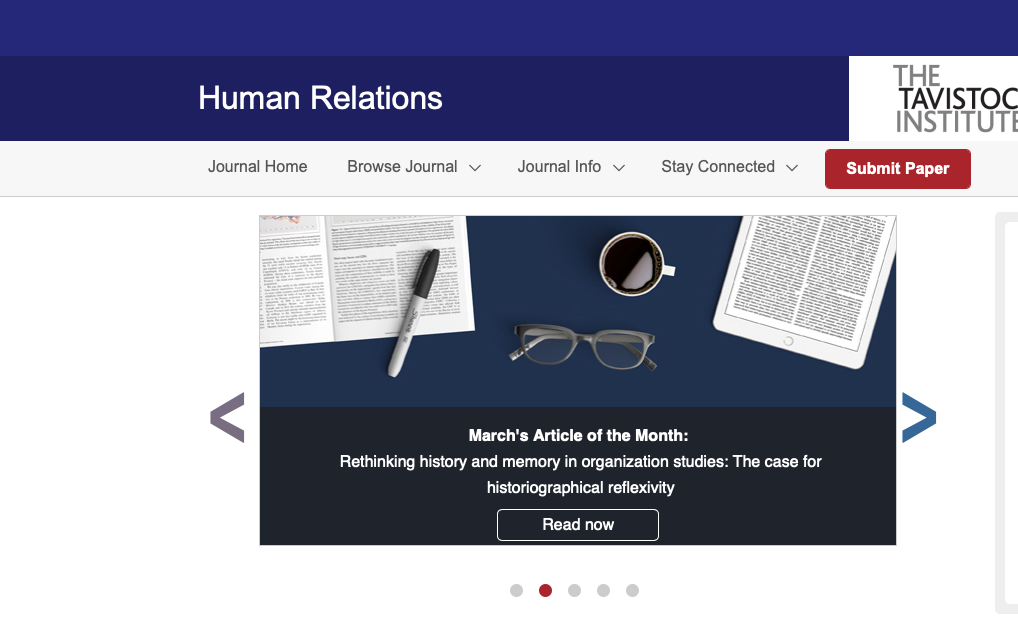
It’s typical of me that only today did I become aware that our article on “Rethinking History and Memory in Organization Studies” (with John Hassard & Mick Rowlinson) has been the Article of the Month in Human Relations for March. Still, very pleased that the journal has highlighted our piece, especially since Human Relations has a great track record for publishing innovative pieces at the intersection of organization research and history.
If you are interested in learning more about how to publish in journals, including Business History, then take a look at this video that was kindly provided by Dr Christian Harrison of the University of West of Scotland. It features a conversation with two journal editors, Prof Laura Galloway, International Journal of Entrepreneurship & Innovation, and Prof Stephanie Decker, Business History.
Proposals for special issues are considered by the editorial team twice a year, once in June and once in December, to allow for a more systematic decision-making process. The deadline for submitting a special issue proposal is the first Friday in June and December.
Proposals should be submitted to the Managing Editor ( businesshistoryeic@gmail.com) and copied to the Joint Editors-in-Chief, Stephanie Decker ( Stephanie.Decker@bristol.ac.uk) and Neil Rollings ( Neil.Rollings@glasgow.ac.uk). Guest editors remain free to submit proposed SIs at any point in the year but the proposals will not be considered until the next deadline. Guest editors will receive a decision shortly after the deadline. The expectation is that up to two special issues will be approved in any round averaging to three being commissioned each year, assuming that they are regarded as of suitable appeal. Decisions will be relayed to the applicants with feedback early in the New Year and the summer depending on the relevant deadline.
Submitted proposals must be fully worked out in advance of submission. Editors remain happy to advise on proposed SIs in advance of any submission but that any revisions requested by the editorial team after submission are expected to be minor.
To this end it is important that potential guest editors acquaint themselves closely with the requirements for a SI proposal. The guidance below is a slightly amended and abridged version of the 2016 editorial on Special Issues. That editorial still forms the basis of our approach to Special Issues but the guidance below reflects our experience since 2016 on the way the process has worked. Rejected proposals can be resubmitted to the next SI competition but only if invited to do so and after significant and substantial revision in line with any feedback offered.
Special Issue Proposal Guidance
Presentation of the topic and the questions to be addressed.
Justification and relevance of the topic. It is important to explain why the proposed Special Issue fits within the remit of Business History, its contribution to business history as a field and why business historians would be interested in the proposed theme.
One to two pages providing a short synthesis of existing debates and the state of literature in the field, research gaps in that field and how the special issue will contribute to fill these gaps. This part should include references.
An outline of the mechanisms to be used to attract high quality articles. This could take the form of an open Call for Papers or an indication of invited contributions emerging from specialised workshops or sessions in conferences or congresses. It is important to show how this process has endeavoured to be inclusive.
Acknowledgment that all the articles proposed for the special issue, including the introductory essay, have not previously been published and are not under consideration elsewhere.
Acknowledgement that all articles will be submitted through the ScholarOne electronic platform for the journal in order to be peer-reviewed before acceptance for publication.
A proposed timetable with deadlines for completion of key milestones, which is to be monitored by the Guest Editors in close coordination with the member of the editorial team assigned to oversee progress on the special issue. The timetable should generally include: the date when a Call for Papers (if relevant) will be published or the dates of a workshop or session in the case of invited articles; the deadline for authors to submit the first version of their article to the ScholarOne website for peer-review evaluation (including the introductory article, which will be handled by the Associate Editor in charge of the special issue); the expected deadline for completion of the peer review process; and a suggested date for final publication. Please note that the final decision on this publication date will be in the hands of the editorial team, who need to take into account other articles accepted for publication in the journal and other special issues.
Guest Editor details, including names, academic affiliation, address and email, accompanied by a short biography with indication of most important research conducted by guest editors, and citations for the last two or three relevant publications related to the topic of the proposed Special Issue.
The #BHC2022MexicoCity and #BHC2022online program is now available. On April 6 participants will be able to attend virtual workshops and April 7 and 8 there will be concurrent sessions running from 7:30 am to 4:30 pm (all times are Mexico Daylight Time). The final day of the 2022 Business History Conference April 9 will focus on in-person activities at the Hotel Maria Isabel in the heart of Mexico City. These include conventional events, such as the Krooss Prize Session and the Prize Ceremony. Some of these events will be hybrid and online registrants will be able to attend them from their computers.
Please share the word, this is the most international program the Business History Conference has organized so far with participants representing more than 200 universities around the world. The broad range of topics is also impressive, from sessions on women in the world of finance to the history of business education around the world.
This editorial introduces the 10 articles included in the special issue on ‘Noblemen-entrepreneurs in the Nineteenth Century. Investments, Innovation, Management and Networks’. The collected works focus on the business activities of noblemen in Europe and Asia, thus offering up opportunities for comparison in an age of economic expansion and globalisation. What was the contribution of the nobility to the economy? Can we consider noblemen to have been endowed with an entrepreneurial spirit? What differences or similarities can we draw between the European and Asian elites? In this introduction, we give a synthetic overview of the relevant issues in the broad topic of the collection and their importance to business history, and briefly present the accepted articles. As two of the articles deal with the Japanese case, while the others focus on Europe, we have dedicated specific sections to the European and Japanese nobilities.
Abe, Takeshi, Izumi Shirai, and Takenobu Yuki. 2022. “Socio-Economic Activities of Former Feudal Lords in Meiji Japan.” Business History 64 (2): 405–33. https://doi.org/10.1080/00076791.2020.1828354.
Conca Messina, Silvia A., and Takeshi Abe. 2022. “Noblemen in Business in the Nineteenth Century: The Survival of an Economic Elite?*.” Business History 64 (2): 207–25. https://doi.org/10.1080/00076791.2021.1972974.
Conca Messina, Silvia A., and Catia Brilli. 2022. “Agriculture and Nobility in Lombardy. Land, Management and Innovation (1815-1861).” Business History 64 (2): 255–79. https://doi.org/10.1080/00076791.2019.1648435.
Felisini, Daniela. 2022. “Far from the Passive Property. An Entrepreneurial Landowner in the Nineteenth Century Papal State.” Business History 64 (2): 226–38. https://doi.org/10.1080/00076791.2019.1597853.
Giner, Begoña, and Amparo Ruiz. 2022. “Family Entrepreneurial Orientation as a Driver of Longevity in Family Firms: A Historic Analysis of the Ennobled Trenor Family and Trenor y Cía.” Business History 64 (2): 327–58. https://doi.org/10.1080/00076791.2020.1801645.
Jensen-Eriksen, Niklas, Saara Hilpinen, and Annette Forsén. 2022. “Nordic Noblemen in Business: The Ehrnrooth Family and the Modernisation of the Finnish Economy during the Late 19th Century.” Business History 64 (2): 385–404. https://doi.org/10.1080/00076791.2020.1828868.
Mata, Maria Eugenia. 2022. “Exemplifying Aristocratic Cross-Border Entrepreneurship before WWI, from a Portuguese Perspective.” Business History 64 (2): 280–96. https://doi.org/10.1080/00076791.2020.1727447.
Nakaoka, Shunsuke. 2022. “A Gateway to the Business World? The Analysis of Networks in Connecting the Modern Japanese Nobility to the Business Elite.” Business History 64 (2): 434–55. https://doi.org/10.1080/00076791.2020.1828353.
Poettinger, Monika. 2022. “An Aristocratic Enterprise: The Ginori Porcelain Manufactory (1735–1896).” Business History 64 (2): 359–84. https://doi.org/10.1080/00076791.2020.1801643.
Tedeschi, Paolo. 2022. “The Noble Entrepreneurs Coming from the Bourgeoisie: Counts Bettoni Cazzago during the Nineteenth Century.” Business History 64 (2): 239–54. https://doi.org/10.1080/00076791.2019.1653283.
Tolaini, Roberto. 2022. “The Genoese Nobility: Land, Finance and Business from Restoration to the First World War.” Business History 64 (2): 297–326. https://doi.org/10.1080/00076791.2020.1801644.
If you wish to send a proposal for a Special Issue, check out the updated policy below
Special issue information [policy]
Proposals for special issues are considered by the editorial team twice a year, once in June and once in December, to allow for a more systematic decision-making process. The deadline for submitting a special issue proposal is the first Friday in June and December.
Proposals should be submitted to the Managing Editor (businesshistoryeic@gmail.com) and copied to the Joint Editors-in-Chief, Stephanie Decker (Stephanie.Decker@bristol.ac.uk) and Neil Rollings (Neil.Rollings@glasgow.ac.uk). Guest editors remain free to submit proposed SIs at any point in the year but the proposals will not be considered until the next deadline. Guest editors will receive a decision shortly after the deadline. The expectation is that up to two special issues will be approved in any round averaging to three being commissioned each year, assuming that they are regarded as of suitable appeal. Decisions will be relayed to the applicants with feedback early in the New Year and the summer depending on the relevant deadline.
Submitted proposals must be fully worked out in advance of submission. Editors remain happy to advise on proposed SIs in advance of any submission but that any revisions requested by the editorial team after submission are expected to be minor. To this end it is important that potential guest editors acquaint themselves closely with the requirements for a SI proposal. The guidance below is a slightly amended and abridged version of the 2016 editorial on Special Issues. That editorial still forms the basis of our approach to Special Issues but the guidance below reflects our experience since 2016 on the way the process has worked. Rejected proposals can be resubmitted to the next SI competition but only if invited to do so and after significant and substantial revision in line with any feedback offered.
Special Issue Proposal Guidance
Presentation of the topic and the questions to be addressed.
Justification and relevance of the topic. It is important to explain why the proposed Special Issue fits within the remit of Business History, its contribution to business history as a field and why business historians would be interested in the proposed theme.
One to two pages providing a short synthesis of existing debates and the state of literature in the field, research gaps in that field and how the special issue will contribute to fill these gaps. This part should include references.
An outline of the mechanisms to be used to attract high quality articles. This could take the form of an open Call for Papers or an indication of invited contributions emerging from specialised workshops or sessions in conferences or congresses. It is important to show how this process has endeavoured to be inclusive.
Acknowledgment that all the articles proposed for the special issue, including the introductory essay, have not previously been published and are not under consideration elsewhere.
Acknowledgement that all articles will be submitted through the ScholarOne electronic platform for the journal in order to be peer-reviewed before acceptance for publication.
A proposed timetable with deadlines for completion of key milestones, which is to be monitored by the Guest Editors in close coordination with the member of the editorial team assigned to oversee progress on the special issue. The timetable should generally include: the date when a Call for Papers (if relevant) will be published or the dates of a workshop or session in the case of invited articles; the deadline for authors to submit the first version of their article to the ScholarOne website for peer-review evaluation (including the introductory article, which will be handled by the Associate Editor in charge of the special issue); the expected deadline for completion of the peer review process; and a suggested date for final publication. Please note that the final decision on this publication date will be in the hands of the editorial team, who need to take into account other articles accepted for publication in the journal and other special issues.
Guest Editor details, including names, academic affiliation, address and email, accompanied by a short biography with indication of most important research conducted by guest editors, and citations for the last two or three relevant publications related to the topic of the proposed Special Issue.
Building on the 30-year legacy of the Hagley Research seminar, the Hagley Seminar on Business, Culture, and Politics features original and creative work in progress essays that make use of business history sources.
All seminars are held on Zoom between noon and 1:30 p.m. Eastern USA time. Seminars are based on a paper that is circulated in advance. Preregistration is required and space is limited. To find registration links as well as additional information on the seminars, please go to https://www.hagley.org/research/research-seminars. Questions may be sent to Carol Lockman, clockman@Hagley.org.
2022 Spring Seminar series
February 23, noon-1:30
Kelly Goodman, West Chester University, “’Let’s Freeze Government Too’: The Business Campaign for Tax Limitation”
Comment: Ben Waterhouse, University of North Carolina, Chapel Hill
March 23, noon-1:30
Dylan Gottlieb, Hagley Library NEH Fellow, “Good Taste: Yuppie Gourmet Culture in the Age of Inequality”
Comment: Amy Bentley, New York University
April 20, noon-1:30
Karen Mahar, Sienna College, “Eugenics and the Creation of the Business Executive, 1900-1920”
Comment: Wendy Gamber, Indiana University
May 18, noon-1:30
Salem Elzway, University of Michigan, “Marxist Manipulators: Robots on the Line at Lordstown”
Comment: Nelson Lichtenstein, University of California, Santa Barbara
The Business History Studies Network (REHE, by its acronym in Spanish) is pleased to be publishing this thirtieth issue of its virtual bulletin. Divided in six sections, the bulletin presents a thorough review of this year’s most important publications and events amongst the business history discipline in Latin America.
Debates (pp. 2-3) reviews the recently published book on Latin American business history. Edited by Andrea Lluch, Martin Monsalve and Marcelo Bucheli, the book compiles 13 chapters about Brazil, Colombia, Chile, Argentina, Perú and México. It also includes chapters on green businesses, women, criminality and violence, transport, family business, business groups and multinationals.
In Novedades (pp. 4-12), eight books are introduced: (2021).The Emergence of Modern Hospital Management and Organisation in the World 1880s-1930s by Fernández, História de empresas no Brasil by Goularti & Macchione Saes (2021), Los reyes del vino. Los Arizu y el esplendor de la Mendoza vitivinícola by Mateu (2021), El viejo y el nuevo poder económico en la argentina del siglo XIX a nuestros días by Schorr (2021), Estado, industria y desarrollo. Atucha II y la senda del Programa Nuclear Argentino (1979-2014) by Rodriguez (2020), Montevideo al Trote. Historia de sus tranvías de caballos by Halaremicz (2021), Historia de la Fundación Mundo Mujer de Popayán (1985-2015) by Molina & Rojas (2021), and Una historia de semillas, plagas, aguas y energía: El algodón y La Laguna (1880-1960) by Rivas Sada (2021).
In this issue, the editors listed call for papers and events (pp. 13-15) for the next year. Recursos (pp. 16-18) presents new academic endeavours during the pandemic such as the Business History Collective (BizHisCol), the Business History TV, and the HBS Creating Emerging -Markets. In Archivos (pp. 19-20), Mariela Ceva (CONICET/CIS-IDES) introduces the Red de Archivos de Empresas en Argentina.
Finally, the section on Tesis (p. 21-22) presents the summary of two doctoral thesis: Beatriz Rodriguez-Satizabal (Queen Mary University of London) on Colombian business groups, 1950-1980 and Carlos Abel Gutiérrez (Universidad Nacional de La Plata) on regional investment in the building sector, 1992-2011.
Welcome back everyone, it is 2022, and who knows what the new year will bring us – normality? more variants? We’ll have to wait and see. In the meantime, Northumbria University’s Business History Group is hosting another event in their seminar series on Teams. If you’d like to join, please contact Dr Ian Jones [ ian.g.jones [at] northumbria.ac.uk].
Business History Group Seminar Series (2021-22)
Wednesday 19th January 2022, 15.00 – 16.00
MS Teams
Medical Risks vs. Financial Rewards: Corporate Social Responsibility in the Global Asbestos Trade, 1930-1977
Dr Jessica van Horssen, Leeds Beckett University.
The history of Corporate Social Responsibility is subject of growing interest for business historians. The research of environmental and business historians as William Cronon and Pierre Desrochers have shown that the decisions of industry leaders have both immediate and long-term local and global effects. With this paper, I will examine the process of decision-making regarding occupational health within the Canadian asbestos trade and show how the corporate social responsibility practiced by industry heads at the local level had much wider effects, including the continuing belief in the safety of asbestos, and the demonization of competitors along racial and political lines.
Picture supplied by Northumbria Business History Group & Dr van Horssen.
Industry leaders knew asbestos was dangerous as early as 1924, but rather than inspire corporate caution, this knowledge was spun to maximize profits while delaying the widespread communication of the risks associated with the mineral. The American Johns-Manville Company was instrumental in this process, as it owned the largest chrysotile asbestos mine in the world, in the town of Asbestos, Canada, and was responsible for turning a potential corporate disaster into an advantage with the “ABC defence.” The “ABC” in this plan referred to “anything but chrysotile,” the particular type of asbestos found in Canada, meaning that asbestos was indeed dangerous, but only when it came from the competition: asbestos from southern Africa was blue, rather than the Canadian white, and therefore branded much more toxic, and asbestos from the Soviet Union, although still white, was tainted communist red at the height of the Cold War, and thus something to be avoided.
The decision to champion Canadian asbestos over its competition on the grounds of safety obscured the industrial and public understanding of the risks associated with the mineral. It also allowed companies like Johns-Manville to manipulate medical evidence to prove their claims correct, and meant that French-Canadian workers in communities like Asbestos, were treated as laboratory mice, monitored and harvested so companies could better understand the progression of disease.
This paper will explore this history while asking questions about corporate social responsibility in single-resource communities and global resource trades. In doing so, I will address key themes in Business History within a transnational context. I will also contribute to the dialogue on decision makers and decision making, while addressing key themes of power, complacency, and control.
Jessica van Horssen is a Senior Lecturer in the School of Cultural Studies and Humanities at Leeds Beckett University. Her research focuses on the history of environmental health in North America and the wider world, highlighting the connections between modernity and toxicity in bodies of land, human bodies and the body politic. Van Horssen’s first book, A Town Called Asbestos: Environmental Contamination, Health and Resilience in a Resources Community (University of British Columbia Press) was published in 2016 and her work has been published in Urban History, Labour/Le Travail, and the Economic History Yearbook. Van Horssen has also worked to raise awareness of contemporary environmental issues, sailing around the UK in 2017 as part of the eXXpedition Round Britain to test coastal waters for plastics contamination, and organising a time travel experience at the Edinburgh Fringe to encourage the public to historicise current pollution levels.



 Organizational History Network