

Author: Steph
I am a professor at the University of Birmingham Business School specializing in organizational history and international strategy.

LAEMOS 2018 – Organizational History & Memory
LAEMOS 2018
Sub-Theme Proposal – Organizational History and Memory
Diego M. Coraiola – Universidade Positivo, Brazil (dcoraiola@gmail.com)
Roy Suddaby – University of Victoria, Canada (rsuddaby@uvic.ca)
Maria Jose Murcia – University of British Columbia, Canada and IAE Universidad Austral, Argentina (majosemurcia@gmail.com)
Mar Pérezts – EMLYON Business School, France (perezts@em-lyon.com)
Bill Cooke – York University, UK (bill.cooke@york.ac.uk)
The notion of organizational resilience implies an implicit theory of organizations in time. Organizational survival lies in the ability of adapting to present and future demands from the environment as well as remaining true to an organization’s essence. Simply put, resilience is about being able to change and yet to remain the same. Reaching a proper balance between the old and the new or the past and the future is an ambidexterous act of exploration and exploitation or a paradox of similarity-distinctiveness. It involves establishing links between the legacies of organizational identities established in the past to aspirational strategies of an imagined future organization. However, there is still little knowledge of how the connections between the present and past of organizational action are created and sustained over time.
There is mixed evidence about the role of the past and history in organization survival. The past, it seems, can both enable and constrain adaptation and change. While for some scholars history defines the boundaries of organizational action and the possibilities of organizational resilience (David, 1985; Hannan & Freeman, 1989; Marquis, 2003; Porter, 1998; Teece, Pisano, & Shuen, 1997), for others the meaning of past actions and events is open for reinterpretation and reshaping through present actions and capabilities. (Coraiola, Foster, & Suddaby, 2015; Mena, Rintamäki, Fleming, & Spicer, 2016; Suddaby & Foster, 2016; Suddaby, Foster, & Trank, 2010; Zundel, Holt, & Popp, 2016). Empirical research on the mnemonics of organizational life might provide a better understanding of the organizational capabilities in generating alternative paths and adapting to changing environmental conditions and at the same time remaining true to themselves.
Our goal for this sub-theme, therefore, is to encourage theory on the mnemonic processes managers and organizations engage with in order to generate continuity and change with the past in ways that assure organizational survival and advantage them in the present and future. This calls for great variety of theoretical perspectives and empirical settings in order to start generating the cumulative evidence about the influences of historical legacies and the organizational ability for managing the past. Submissions focusing on the mnemonics of organizational resilience could look at:
- What are the implications of past managerial action for organizational success and survival (Greve & Rao, 2014; Marquis, 2003; Schrempf-Stirling, Palazzo, & Phillips, 2016; Sydow & Schreyögg, 2013)?
- What are the practices and routines organizations engage with in order to balance the reproduction and renovation of the past (Coraiola, Suddaby, Foster, 2017; Suddaby, Foster, Quinn-Trank, 2010)?
- How managers use history to manage processes of organizational change (Brunninge, 2009; Maclean, Harvey, Sillince, & Golant, 2014; Ybema, 2010)?
- How organizational identity is created and reproduced over time through various processes of remembering and forgetting (Anteby & Molnár, 2012; Ravasi & Schultz, 2006; Schultz & Hernes, 2013; Suddaby, Foster, & Trank, 2016)?
- How organizations develop mnemonic practices to manage legitimacy threats and corporate scandals (Janssen, 2012; Mena, Rintamäki, Fleming, & Spicer, 2016)?
- What are the boundary conditions around the uses of organizational mnemonics to foster organizational resilience (Foster, Coraiola, Suddaby, Kroezen, & Chandler, Forthcoming; Zundel et al, 2016)?
- How management and organization scholars contribute to the understanding and the engagement of managers and organizations with the past (Lasewicz, 2015; Suddaby, 2016; Taylor, Bell, & Cooke, 2009).
The focus of this sub-theme is thus to provide new and more encompassing evidence about the enabling and constraining effects of the past for organizational resilience and survival. Researchers are encouraged to submit papers for this sub-theme with theoretical, methodological, and empirical contributions. Our goal is to foster discussions around the influence of the past, present, and future of managerial action on organizational continuity and change.
References
Anteby, M., & Molnár, V. (2012). Collective Memory Meets Organizational Identity: Remembering to Forget in a Firm’s Rhetorical History. Academy of Management Journal, 55(3), 515-540.
Brunninge, O. (2009). Using history in organizations: How managers make purposeful reference to history in strategy processes. Journal of Organizational Change Management, 22(1), 8-26.
Coraiola, D. M., Foster, W. M., & Suddaby, R. (2015). Varieties of History in Organization Studies. In P. G. McLaren, A. J. Mills & T. G. Weatherbee (Eds.), The Routledge Companion to Management & Organizational History (pp. 206-221). New York: Routledge.
David, P. A. (1985). Clio and the Economics of QWERTY. The American Economic Review, 75(2), 332-337.
Foster, W. M., Coraiola, D. M., Suddaby, R., Kroezen, J., & Chandler, D. (Forthcoming). The strategic use of historical narratives: A theoretical framework. Business History.
Greve, H. R., & Rao, H. (2014). History and the present: Institutional legacies in communities of organizations. Research in organizational behavior, 34, 27-41.
Hannan, M. T., & Freeman, J. (1989). Organizational Ecology. New York: Oxford University Press.
Janssen, C. I. (2012). Addressing Corporate Ties to Slavery: Corporate Apologia in a Discourse of Reconciliation. Communication Studies, 63(1), 18-35.
Lasewicz, P. C. (2015). Forget the Past? Or History Matters? Selected Academic Perspectives on the Strategic Value of Organizational Pasts. The American Archivist, 78(1), 59-83.
Maclean, M., Harvey, C., Sillince, J. A. A., & Golant, B. D. (2014). Living up to the past? Ideological sensemaking in organizational transition. Organization, 21(4), 543-567.
Marquis, C. (2003). The Pressure of the Past: Network Imprinting in Intercorporate Communities. Administrative Science Quarterly, 48(4), 655-689.
Mena, S., Rintamäki, J., Fleming, P., & Spicer, A. (2016). On the Forgetting of Corporate Irresponsibility. Academy of Management Review, 41(4), 720-738.
Porter, M. E. (1998). Cluster and the new economics of competition. Harvard Business Review, 76(6), 77-90.
Ravasi, D., & Schultz, M. (2006). Responding to organizational identity threats: Exploring the role of organizational culture. Academy of Management Journal, 49(3), 433-458.
Schrempf-Stirling, J., Palazzo, G., & Phillips, R. (2016). Historic Corporate Social Responsibility. Academy of Management Review, 41(4), 700-719.
Schultz, M., & Hernes, T. (2013). A Temporal Perspective on Organizational Identity. Organization Science, 24(1), 1-21.
Suddaby, R. (2016). Toward a Historical Consciousness: Following the Historic Turn in Management Thought. M@n@gement: Revue officielle de l’Association Internationale de Management Stratégique, 19(1), 46-60.
Suddaby, R., & Foster, W. M. (2016). History and Organizational Change. Journal of Management, 43(1), 19-38.
Suddaby, R., Foster, W. M., & Trank, C. Q. (2010). Rhetorical history as a source of competitive advantage. In J. A. C. Baum & J. Lampel (Eds.), Advances in Strategic Management: The Globalization of Strategy Research (pp. 147-173). Bingley: Emerald.
Suddaby, R., Foster, W. M., & Trank, C. Q. (2016). Re-membering: Rhetorical History as Identity-Work. In M. G. Pratt , M. Schultz, B. E. Ashforth & D. Ravasi (Eds.), The Oxford Handbook of Organizational Identity (pp. 297-316). Oxford: Oxford University Press.
Sydow, J., & Schreyögg, G. (2013). Self-reinforcing processes in and among organizations. Hampshire: Palgrave.
Taylor, S., Bell, E., & Cooke, B. (2009). Business history and the historiographical operation. Management & Organizational History, 4(2), 151-166.
Teece, D. J., Pisano, G., & Shuen, A. (1997). Dynamic Capabilities and Strategic Management. Strategic Management Journal, 18(7), 509-533.
Ybema, S. (2010). Talk of change: Temporal contrasts and collective identities. Organization Studies, 31(4), 481-503.
Zundel, M., Holt, R., & Popp, A. (2016). Using history in the creation of organizational identity. Management & Organizational History, 1-25.
Note: We thank Maria Del Pilar Acosta Collazos, Sébastien Mena, and William M. Foster for their contribution in developing the proposal for this sub-theme.
Moshik Temkin’s Assertions about the Limits of Analogical-Historical Reasoning
Reblogged from The Past Speaks:

Moshik Temkin is an associate professor of history and public policy at the Harvard Kennedy School. He recently published a piece in the New York Times on the limits of analogical historical reasoning. He observes that the chaotic Trump presidency has increased the demand for the services of historians.
Donald Trump might be disastrous for most Americans and a danger to the world, but he has been a boon to historians. The more grotesque his presidency appears, the more historians are called on to make sense of it, often in 30-second blasts on cable news or in quick-take quotes in a news article.
Temkin notes that one of the most popular analogies used to understand Trump is the Nixon presidency. Temkin cautions against the use of this historical analogy and all of the other historical analogies currently being used to make sense of Trump. He writes that
We teach our…
View original post 983 more words
Management History Research Group Annual Workshop, 2017
Reblogged from The Past Speaks:
July 10-11th 2017, People’s History Museum, Manchester, Left Bank, Spinningfields, M3 3ER
| Paper Session 2A: Labour, Management and Democracy Chair: Peter Hampson, Location: Coal Store |
| Swapnesh Masrani and Linda Perriton |
| Getting together, living together, thinking together: Tata Sons’ Staff College in the 1940s |
| Nicola Bishop |
| The Middle-Class Clerk as British Cultural ‘Everyman’ |
| Bill Cooke |
| McCarthyism and Loyalty Oaths 2.0: Signs and Strategies from History |
| Paper Session 2B: Strategies, Numbers, Codes and Machines Chair: Chris Corker, Location: Meeting Room |
| Joseph Lampel, Ali Bayat and Mercedes Bleda |
| The National Response to Global Educational Metrics: When Do Governments Fall into Line? |
| Philip Garnett and Simon Mollan |
| The Business of Cryptography |
| Kevin Tennent |
| Le Corbusier, the town planners, and the corporate strategists. Or, the Corporation as a Machine for Working In |
Paper session 3: Communities, Crises and Survival. Chair: Des Williamson. Location: Coal Store
John Singleton
Approaches to Safety Management in Early…
View original post 174 more words
Workshop report: Pop Nostalgia
The German Historical Institute published a workshop report on an interesting event on pop nostalgia & uses of the past that took place last year here: https://www.ghil.ac.uk/pop_nostalgia.html
Pop Nostalgia: The Uses of the Past in Popular Culture

Pop nostalgia, we are told, is everywhere. Our current golden age of television—from Mad Men to Vinyl, Downton Abbey to Call the Midwife—lovingly recreates earlier periods of the twentieth century, while club nights devoted to the 1980s or 1990s allow us to return to our youth. What is more, popular culture is, in the words of music journalist Simon Reynolds, addicted to its own past. It not only reminisces, it revives, reissues, remixes earlier forms and styles instead of coming up with genuinely new. Finally, our most modern technologies are always also time machines: producing sepia-coloured images of the present for an anticipated nostalgic recollection in the future.
These very different cultural phenomena, which are often subsumed under the term nostalgia, raise a number of still under-explored questions. How new is this development, given that period films are as old as the cinema and that popular culture and music has drawn on earlier periods as long as it exists? Can the recycling of old styles and forms not also be highly creative and result in innovations? Are period settings and costumes, retro and vintage styles as such indicative and synonymous with nostalgia? Is it really nostalgia that drives our interest in and our engagement with the past? And if not what other motivations are at play? What role, for example, have media technologies such as film and the internet played in preserving the culture of the past in the present?
These are some of the questions the workshop Pop Nostalgia addresses. It explores the uses of the past in popular culture across all media and genre, from literature, cinema, television, and video games to theme park, club nights and sports events. It is interested not only in representations of the past but also in their production and circulation as well as in audiences and reception. The workshop is particularly interested in the historical dimension of pop nostalgia.
New article on History Reframing Institutional Logics
And we are happy to announce another great contribution to the ongoing debate on organizational history:
PRACTICE, SUBSTANCE AND HISTORY: REFRAMING INSTITUTIONAL LOGICS
- Alistair Mutch⇑
Nottingham Business School, Nottingham trent University, Nottingham, NG1 4BU, United Kingdom of Great Britain and Northern Ireland
- Correspondence: Alistair Mutch, Email: alistair.mutch@ntu.ac.uk
Abstract
The characterization by Roger Friedland of institutional logics as a combination of substance and practices opens the door to a more complex reading of their influence on organizational life. His focus suggests attention to feelings and belief as much as cognition and choice. This article uses history to develop these ideas by paying attention to the perennial features of our embodied relations with the world and other persons. Historical work draws our attention to neglected domains of social life, such as play, which can have profound impacts on organizations. The study of history suggests that such institutions have a long run conditioning influence that calls into question accounts that stress individual agential choice and action in bringing about change. Analytical narratives of the emergence of practices can provide the means to combine the conceptual apparatus of organization theory with the attention to temporality of history.
- Received September 10, 2015.
- Revision received May 9, 2017.
- Accepted May 12, 2017.
Reflections on ABH 2017
Reblogged from The Past Speaks:
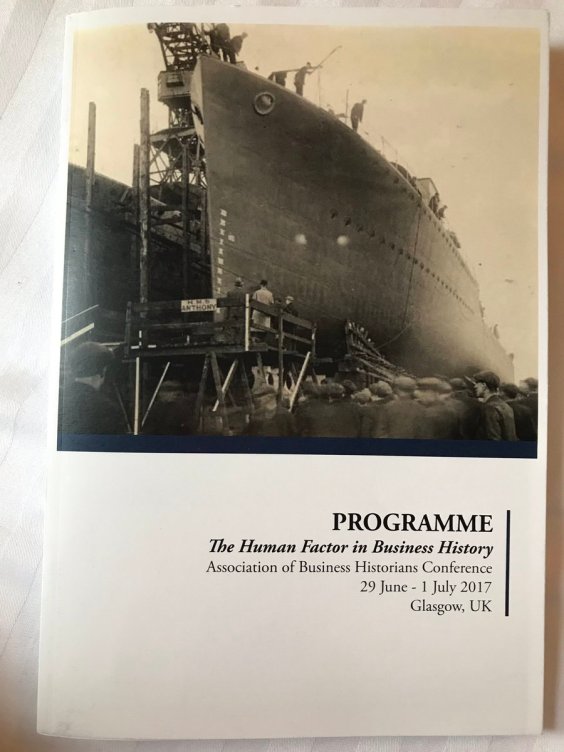
The Association of Business Historians conference 2017 was a brilliant success thanks to the hard work of the organizing committee in Glasgow. In addition to the excellent academic sessions, the conference included many additional social events, including a Ceilidh. I’m sharing some images of both below.
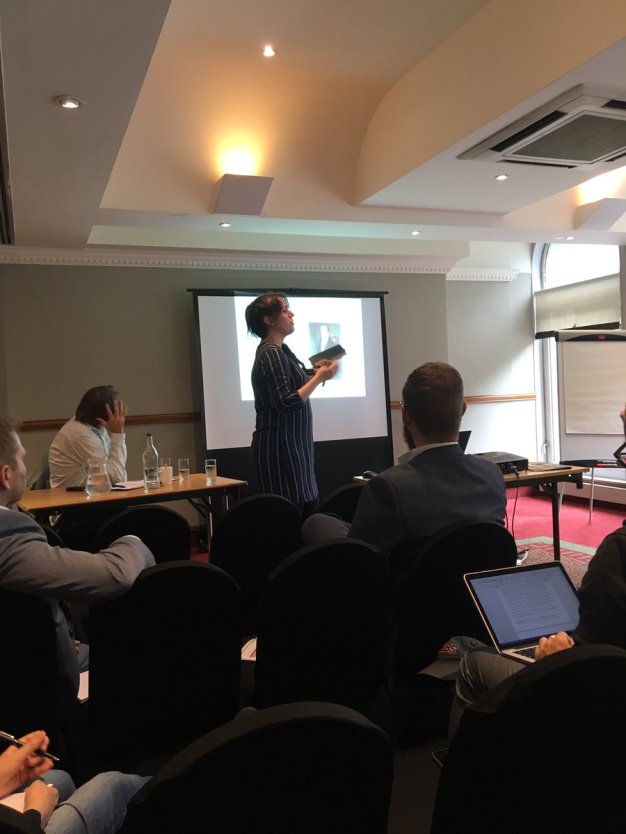 @zoipittaki on the word ‘entrepreneur’ in four languages and the frequency of the use of the ‘entrepreneur’ #abh2017 #Glasgow Photo by Maelle Duchemin-Pell
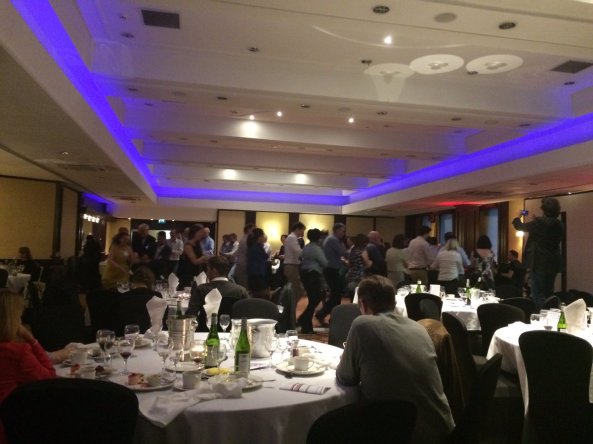
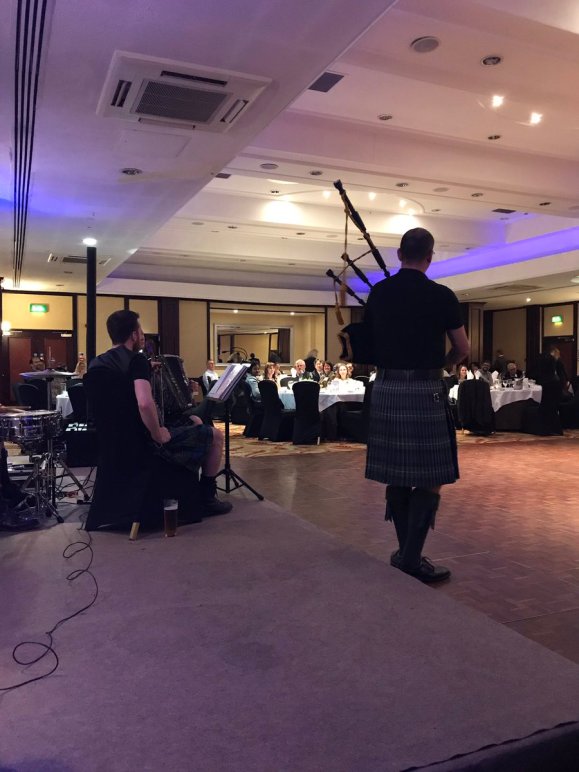
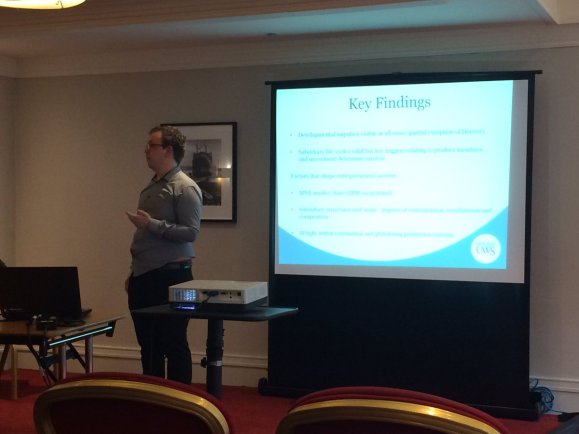 @ewangibbs on US manufacturing multinationals in #Scotland #abh2017 #Glasgow
ToCs: BH 59,6
Business History, Volume 59, Issue 6, September 2017 is now available online on Taylor & Francis Online.
Original Articles
Corporations as agents of social change: A case study of diversity at Cummins Inc.
Heidi Reed
Pages: 821-843 | DOI: 10.1080/00076791.2016.1255196
‘A highly successful model’? The rail franchising business in Britain
Robert Jupe & Warwick Funnell
Pages: 844-876 | DOI: 10.1080/00076791.2016.1270268
Reaching for global in the Japanese cosmetics industry, 1951 to 2015: the case of Shiseido
Maki Umemura & Stephanie Slater
Pages: 877-903 | DOI: 10.1080/00076791.2016.1274735
Clio in the business school: Historical approaches in strategy, international business and entrepreneurship
Andrew Perchard http://orcid.org/0000-0003-3227-6485, Niall G. MacKenzie, Stephanie Decker http://orcid.org/0000-0003-0547-9594 & Giovanni Favero
Pages: 904-927 | DOI: 10.1080/00076791.2017.1280025
Business success and the architectural practice of Sir George Gilbert Scott, c.1845–1878: a study in hard work, sound management and networks of trust
Sam McKinstry & Ying Yong Ding
Pages: 928-950 | DOI: 10.1080/00076791.2017.1288216
Religious minority in business history: The case of Old Believers
Danila Raskov http://orcid.org/0000-0003-2173-5949 & Vadim Kufenko http://orcid.org/0000-0003-4927-8815
Pages: 951-974 | DOI: 10.1080/00076791.2017.1288217
Book review
Histoire de l’emballage en France, du xviiie siècle à nos jours
Hubert Bonin
Pages: 975-976 | DOI: 10.1080/00076791.2015.1129777
La doyenne des «Sénégalaises» de Bordeaux: Maurel et H. Prom de 1831 à 1919, tome I. De l’édification à la période africaine; tome II. Maurel & H.Prom en Afrique
Hubert Bonin
Pages: 977-979 | DOI: 10.1080/00076791.2015.1130252
El Banco de Barcelona, 1874–1920. Decadencia y quiebra
José L. García-Ruiz http://orcid.org/0000-0002-3612-6217
Pages: 979-981 | DOI: 10.1080/00076791.2016.1276676
Family multinationals. Entrepreneurship, governance, and pathways to internationalization
Hans Sjögren
Pages: 981-983 | DOI: 10.1080/00076791.2017.1306349
Innovation and creativity in late medieval and early modern European Cities
Pamela H. Smith
Pages: 983-985 | DOI: 10.1080/00076791.2017.1307166
New article in Organizational History
I’m very pleased that one of my joint-authored article has been published. Thanks again to the great group at EGOS who discussed a much earlier version of our paper in 2014!
Clio in the business school: Historical approaches in strategy, international business and entrepreneurship

Abstract
On the back of recent and significant new debates on the use of history within business and management studies, we consider the perception of historians as being anti-theory and of having methodological shortcomings; and business and management scholars displaying insufficient attention to historical context and privileging of certain social science methods over others. These are explored through an examination of three subjects: strategy, international business and entrepreneurship. We propose a framework for advancing the use of history within business and management studies more generally through greater understanding of historical perspectives and methodologies.
 Organizational History Network